
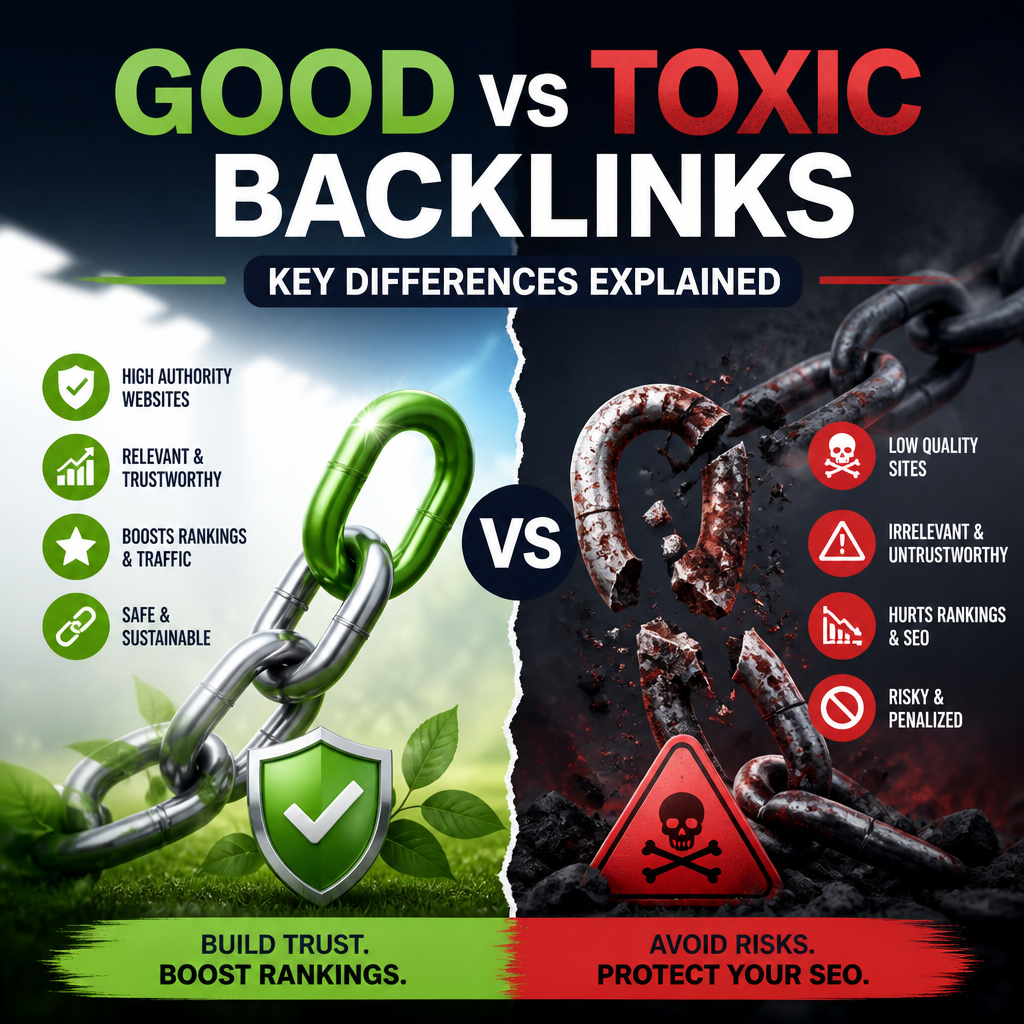
Good Backlinks vs. Toxic Backlinks: Key Differences Explained
The Difference Between Good Backlinks and Toxic Backlinks
Backlinks remain one of the most important concepts in search engine optimization. When another website links to your page, it can send referral traffic, increase brand visibility, and signal that your content is useful or trustworthy. However, not every backlink is beneficial.
Some links strengthen a website’s authority and support long-term rankings. Others can weaken a site’s reputation, waste valuable SEO resources, or create problems when they appear manipulative. Understanding the difference between good backlinks and toxic backlinks is essential for building a sustainable link profile.
This guide explains what makes a backlink valuable, how toxic links develop, the warning signs to watch for, and the practical steps you can take to earn, evaluate, and manage links effectively.
What Is a Backlink?
A backlink is a hyperlink from one website to another. For example, if an industry publication links to an article on your website, your site has received a backlink from that publication.
Backlinks can appear in several places, including:
- Editorial articles
- Product reviews
- Resource pages
- Business directories
- News coverage
- Guest posts
- Forum discussions
- Blog comments
- Partner or supplier pages
Search engines use links as part of their systems for discovering and evaluating web pages. A link can act as a recommendation, suggesting that the destination page contains useful information.
However, search engines do not treat every link equally. The value of a backlink depends on factors such as:
- The relevance of the linking website
- The quality and originality of its content
- The context surrounding the link
- The reputation of the referring domain
- Whether the link was earned naturally or created manipulatively
- The anchor text used
- The technical attributes attached to the link
A backlink is therefore not automatically good simply because it exists. Its value comes from the circumstances behind it.
What Is a Good Backlink?
A good backlink is a relevant, trustworthy, and naturally placed link that helps users discover valuable information. It usually comes from a legitimate website with a real audience and a clear connection to the topic being discussed.
Good backlinks support both users and search engines. A reader can follow the link to learn more, verify a claim, find a source, or explore a related product or service. Because the link makes sense in context, it appears editorial rather than forced.
Characteristics of a Good Backlink
A high-quality backlink commonly has the following qualities:
- It comes from a reputable website.
- The linking page is relevant to your topic.
- The link is placed within useful, original content.
- It provides genuine value to the reader.
- It uses natural anchor text.
- It is surrounded by meaningful context.
- The referring website has real visitors and engagement.
- It was earned through content, expertise, relationships, or legitimate promotion.
- It is not part of a large-scale link scheme.
For example, imagine that a respected accounting publication publishes an article about tax planning for small businesses and links to your detailed guide on deductible expenses. The link is relevant, useful, and editorially justified. It may send qualified referral traffic and provide a positive trust signal.
What Is a Toxic Backlink?
A toxic backlink is a link that may harm a website’s SEO performance or expose it to search engine quality concerns. Toxic links are often associated with spam, manipulation, irrelevant placements, hacked websites, or low-quality link networks.
The word “toxic” is not an official classification applied uniformly to every backlink. SEO tools commonly use the term to describe links with potentially harmful characteristics. A link flagged by a third-party tool is not automatically dangerous, and the presence of a suspicious link does not necessarily mean that a penalty has occurred.
Still, toxic links deserve investigation. A website with many unnatural or manipulative links may struggle to perform well, particularly when those links were created to influence rankings rather than help users.
Common Characteristics of Toxic Backlinks
Toxic backlinks may have one or more of these traits:
- They come from websites created primarily for linking.
- They appear on irrelevant or low-quality pages.
- They are surrounded by spun, copied, or nonsensical content.
- They use aggressive exact-match anchor text repeatedly.
- They are placed in paid articles without appropriate disclosure or link attributes.
- They come from hacked or compromised websites.
- They are generated through automated tools.
- They appear in private blog networks designed to manipulate rankings.
- They originate from pages overloaded with unrelated outbound links.
- They are hidden from users through styling or code.
- They are placed in comment sections, forums, or directories solely for SEO purposes.
- They come from domains with a history of spam or deceptive activity.
For example, a backlink from a page titled “Best Online Services” that lists hundreds of unrelated websites and contains barely readable text is unlikely to provide meaningful value. If the link was created solely to manipulate rankings, it may be considered unnatural.
Why Good Backlinks Matter
A strong backlink profile can benefit a website in several ways.
Improved Search Visibility
Links help search engines discover pages and understand relationships between websites. When authoritative, relevant websites link to your content, those links may contribute to stronger organic visibility.
Backlinks are not the only ranking factor, but they remain an important part of how search engines assess authority and prominence.
Referral Traffic
A useful backlink can bring visitors directly from the referring website. This traffic may be especially valuable when it comes from a publication, community, or industry resource that serves the same audience as your business.
Referral visitors are often more qualified because they have already shown interest in the topic by clicking the link.
Increased Brand Exposure
Being mentioned on respected websites can introduce your brand to new audiences. Even when a backlink does not directly improve rankings, the exposure may lead to:
- Brand searches
- Newsletter signups
- Product inquiries
- Social sharing
- Media coverage
- Business partnerships
Greater Credibility
A link from a trusted source can reinforce your reputation. For example, a university, industry association, respected news outlet, or established professional publication may lend credibility to a company or individual.
This benefit is not purely technical. People often use external references to judge whether a brand is reliable.
Why Toxic Backlinks Can Be Harmful
Toxic backlinks are not always immediately damaging, but they can create several risks.
Algorithmic Suppression
Search engines may discount unnatural links rather than passing value through them. In some cases, a pattern of manipulative links may contribute to reduced visibility.
Modern search systems are designed to identify and ignore many spam links automatically. However, relying on automatic protection is not a reason to deliberately build risky links.
Manual Actions
A manual action can occur when a search engine reviewer determines that a site violates quality guidelines. Unnatural inbound links are one possible reason for a manual action.
This situation may require identifying the problematic links, removing them where possible, submitting a disavow file when appropriate, and requesting a review after correcting the issue.
Wasted Resources
Time and money spent acquiring poor-quality links could have been used to create useful content, develop partnerships, improve technical SEO, or earn legitimate media coverage.
A large number of low-quality links may create the appearance of progress while delivering little business value.
Reputation Damage
Links from spammy, deceptive, or offensive websites can create reputational concerns. Customers, partners, and journalists may form negative impressions when they encounter a brand associated with questionable pages.
Unnatural Link Profile Patterns
A website may attract scrutiny when its backlink profile shows obvious manipulation, such as:
- A sudden surge of thousands of links
- Repeated keyword-rich anchor text
- Many links from unrelated foreign-language sites
- Large numbers of links from the same network
- Sitewide links across unrelated websites
- Links that do not produce any meaningful referral traffic
A single strange link is rarely a serious problem. Patterns matter more than isolated incidents.
Good Backlinks Versus Toxic Backlinks
The difference becomes clearer when the two types are compared directly.
| Factor | Good Backlink | Toxic Backlink |
|---|---|---|
| Relevance | Closely related to the topic | Unrelated to the destination page |
| Source quality | Reputable, maintained website | Spammy, hacked, abandoned, or artificial site |
| Placement | Naturally included in useful content | Hidden, forced, or placed in low-value content |
| Audience | Has real readers and engagement | Exists mainly to host links |
| Anchor text | Natural and varied | Repeated exact-match commercial keywords |
| Intent | Helps users find additional information | Created mainly to manipulate rankings |
| Content | Original and informative | Thin, copied, spun, or nonsensical |
| Link pattern | Earned through legitimate activity | Generated in bulk or through schemes |
| Business value | Can bring relevant traffic or visibility | Usually brings no meaningful visitors |
| Risk level | Low | Potentially high |
Examples of Good Backlinks
Editorial Citation
A health publication writes an evidence-based article about sleep and links to your research-backed guide on sleep hygiene as a supporting resource.
Why it is good:
- The subject matter is closely related.
- The link supports a factual claim.
- The publication has an audience interested in the topic.
- The placement is editorial and useful.
Industry Resource Page
A professional association maintains a resource page for small business owners and includes your free budgeting template.
Why it is good:
- The resource is genuinely useful.
- The linking organization is relevant.
- Visitors may actively seek the information.
- The link can generate qualified referral traffic.
Product Review
A respected technology reviewer tests your software and links to the product page for readers who want additional details.
Why it is good:
- The link is connected to a real review.
- The reviewer has an identifiable audience.
- The link helps readers evaluate or access the product.
Digital Public Relations
A news website covers your original industry research and links to the report published on your site.
Why it is good:
- The link is earned through newsworthy information.
- It reinforces your expertise.
- It may produce visibility beyond SEO.
Examples of Toxic Backlinks
Automated Directory Links
Hundreds of directories list your website under unrelated categories, often using identical descriptions and keyword-heavy anchor text.
Why it is risky:
- The links may have been created automatically.
- The directories may contain little useful information.
- The pattern suggests manipulation rather than genuine citation.
Private Blog Network Links
A group of websites owned or controlled by the same party publishes thin articles that link to target websites.
Why it is risky:
- The network exists primarily to influence rankings.
- Content is often repetitive or low quality.
- The links may be detected as part of an artificial scheme.
Irrelevant Paid Guest Posts
A website unrelated to your industry publishes a generic article containing several commercial links to your pages.
Why it is risky:
- The content may exist only to sell links.
- The topic and audience do not match.
- Multiple outbound links may reduce the page’s credibility.
Comment Spam
An automated account posts comments across blogs with keyword-rich links back to your website.
Why it is risky:
- The links are unsolicited and irrelevant.
- The comments are often deleted or marked as spam.
- The activity may create a recognizable manipulation pattern.
Hacked Website Links
A compromised website contains hidden links to unrelated commercial pages, including your domain.
Why it is risky:
- The placement was not editorial.
- The link may be hidden from ordinary visitors.
- The referring site itself may be compromised or penalized.
The Importance of Relevance
Relevance is one of the strongest indicators of backlink quality. A link from a smaller but highly relevant website can be more useful than a link from a large website with no connection to your subject.
For example, a backlink to a commercial bakery from a local food magazine may be valuable even if the magazine has less overall authority than a general news website. The audience, location, and subject matter align with the business.
Relevance can exist at several levels:
- Industry relevance
- Geographic relevance
- Audience relevance
- Topical relevance
- Content relevance
A page about home gardening linking to a guide about soil preparation makes sense. The same page linking to an unrelated payday loan service does not.
Anchor Text: Natural Versus Manipulative
Anchor text is the clickable wording used in a hyperlink. It provides context about the destination page.
Natural anchor text may include:
- The brand name
- The page title
- A descriptive phrase
- A website address
- Neutral wording such as “this guide” or “learn more”
Manipulative anchor text often repeats highly specific commercial keywords, such as:
- “cheap blue running shoes”
- “best personal injury lawyer”
- “affordable online casino”
- “buy discount software”
Keyword-rich anchor text is not automatically toxic. It can be appropriate when it accurately describes the destination. The concern arises when the same commercial phrase appears unnaturally across many unrelated websites.
A healthy backlink profile usually contains variation rather than a single repeated phrase.
Domain Authority Is Not the Whole Story
Many SEO tools assign authority or toxicity scores to referring domains. These metrics can be useful for organizing research, but they should not be treated as absolute judgments.
A website with a high authority score may still publish irrelevant or paid content. A smaller website may have modest metrics but offer a highly relevant audience and a genuine editorial environment.
When evaluating a backlink, consider more than a numerical score:
- Does the website publish real content?
- Is the content maintained?
- Does it have a recognizable audience?
- Is the site relevant to your business?
- Are the links editorially justified?
- Does the page look trustworthy to a human visitor?
- Would you still value the mention if search engines did not exist?
That final question is particularly useful. If the answer is yes, the link is more likely to have genuine value.
How to Audit Your Backlink Profile
A backlink audit involves reviewing the links pointing to your website and identifying opportunities, risks, and patterns.
1. Collect Backlink Data
Use reliable sources such as:
- Google Search Console
- Commercial SEO platforms
- Server analytics
- Referral traffic reports
- Internal link and outreach records
No tool sees every backlink, so combining multiple sources can produce a more complete picture.
2. Review the Referring Domain
Examine the website linking to you. Look for:
- A clear purpose
- Original content
- Active publishing
- Real contact or company information
- Relevant topics
- Signs of genuine readership
- Excessive advertising or outbound links
Do not judge a domain solely by its design. Some legitimate websites have simple layouts, while some spam sites look polished.
3. Inspect the Exact Linking Page
A domain may be generally legitimate while one page is suspicious. Open the specific URL and ask:
- Is the page indexed?
- Does the content make sense?
- Is your link relevant?
- Is the page overloaded with links?
- Does the content appear copied or automatically generated?
- Is the link visible and useful to readers?
- Was the page created solely to host links?
4. Check Anchor Text
Look for overuse of commercial keywords or suspicious repetition. Compare the anchor text distribution across your entire backlink profile rather than focusing on one link.
5. Look for Patterns
Patterns often reveal manipulation more effectively than individual links. Check for:
- Many links acquired at the same time
- Links from related domains with similar layouts
- Identical article templates
- The same anchor text across many websites
- Links from multiple sites sharing an IP or ownership pattern
- Sudden growth with no corresponding publicity or content campaign
6. Assess Business Value
Determine whether the links produce:
- Referral visitors
- Brand mentions
- Leads or sales
- Industry relationships
- Press opportunities
- Relevant audience exposure
A link that brings qualified visitors may be valuable even if it has limited measurable SEO authority.
What to Do About Suspicious Backlinks
Not every suspicious backlink requires immediate removal. Search engines often ignore low-quality links when there is no evidence that the site owner created them deliberately.
Contact the Website Owner
If a backlink is clearly manipulative and you know who controls the referring site, request removal. Keep the request brief and professional. Document the date, recipient, and outcome.
You do not need to contact hundreds of sites repeatedly. Focus on links that appear especially dangerous, artificial, or connected to a known campaign.
Use the Disavow Tool Carefully
A disavow file tells a search engine that you do not want certain links considered when evaluating your site. It should be used cautiously, not as a routine response to every low-authority link.
Disavowal may be appropriate when:
- You have a significant number of artificial links.
- You or an SEO provider created manipulative links in the past.
- You received a manual action related to unnatural links.
- You cannot remove clearly harmful links after reasonable outreach.
- There is evidence of a deliberate negative SEO or spam campaign.
Before submitting a disavow file, review the links carefully. Removing credit from legitimate links can be counterproductive.
Improve the Overall Profile
The best long-term response to questionable links is to earn more legitimate ones. Strong content, useful resources, public relations, expert contributions, and professional relationships can gradually improve the balance of your link profile.
How to Earn More Good Backlinks
Create Original Research
Original data, surveys, case studies, and industry reports are naturally linkable because other publishers need credible sources.
Include:
- Clear methodology
- Useful statistics
- Visual charts
- Expert commentary
- Downloadable findings
- Quotable insights
Publish Practical Resources
Templates, calculators, checklists, tutorials, glossaries, and detailed guides can attract links from websites that want to help their audiences.
The resource should solve a real problem rather than simply target a keyword.
Develop Expert Content
Contributors who demonstrate first-hand experience and subject expertise are more likely to earn recognition. Publish clear explanations, original perspectives, and examples that go beyond information already available elsewhere.
Build Industry Relationships
Legitimate relationships can lead to interviews, collaborations, event coverage, partnerships, and editorial mentions.
Useful relationship-building activities include:
- Participating in professional associations
- Speaking at relevant events
- Contributing expert quotes
- Collaborating on research
- Supporting community initiatives
- Networking with journalists and publishers
Use Digital Public Relations
Newsworthy announcements, original studies, expert commentary, and compelling stories can earn coverage from media outlets and specialized publications.
Digital PR works best when the story has value beyond promoting a company’s services.
Reclaim Unlinked Mentions
Sometimes websites mention your brand, employees, research, or products without linking to you. Contact the publisher politely and ask whether they would consider adding a relevant link for readers.
Fix Broken Links
Find relevant websites linking to outdated or broken resources. If you have a better replacement, contact the site owner and explain how your page can help visitors.
This approach is useful because it improves the linking website’s user experience while earning a relevant mention.
Promote Content Strategically
Content does not earn links simply because it exists. Share important resources with journalists, professional communities, newsletter publishers, and organizations that are likely to find them genuinely useful.
Promotion should be targeted and relevant rather than automated or excessive.
Common Misconceptions About Backlinks
“Every Backlink Is Good”
A link is not valuable merely because it points to your website. Relevance, quality, context, and intent all matter.
“One Bad Link Will Destroy a Website”
Search engines generally evaluate link patterns rather than punishing a site for every unexpected link. A single suspicious backlink is rarely a disaster.
“High Domain Authority Guarantees Quality”
Third-party metrics are estimates. A high score does not prove that a link is relevant, editorial, or safe.
“More Links Always Mean Better Rankings”
Large quantities of low-quality links can be less useful than a small number of relevant, editorial links. Quality and context are more important than volume.
“Disavow Every Link With a Low Score”
Tool-generated toxicity scores should guide investigation, not replace judgment. Disavowing legitimate links unnecessarily can remove useful signals.
“Paid Links Are Always Toxic”
Paid advertising and sponsorships are legitimate marketing activities. The concern arises when paid links pass ranking signals without appropriate disclosure or attributes, or when they are part of a broader manipulation scheme.
A Practical Backlink Quality Checklist
Before pursuing or keeping a backlink, ask:
- Is the referring website legitimate?
- Is the page relevant to my topic or audience?
- Does the link help users?
- Is the content original and readable?
- Does the site have a real purpose beyond hosting links?
- Is the anchor text natural?
- Does the page contain an excessive number of outbound links?
- Was the link earned through legitimate promotion or editorial interest?
- Could the link bring relevant referral traffic?
- Would I want this link if it had no SEO benefit?
- Does the link form part of a suspicious pattern?
The more questions a link answers positively, the more likely it is to be beneficial.
Conclusion
Good backlinks are relevant, trustworthy, naturally placed links that help users discover valuable information. Toxic backlinks are typically associated with spam, manipulation, irrelevance, artificial networks, or low-quality pages created primarily to influence rankings.
The goal of link building should not be to collect as many links as possible. It should be to earn credible mentions from websites that genuinely serve your audience. Create useful resources, publish original insights, build authentic industry relationships, and evaluate links based on context rather than simplistic metrics.
A healthy backlink profile is built gradually. When quality, relevance, and user value guide your strategy, backlinks become more than ranking signals—they become lasting sources of traffic, credibility, and brand growth.
