
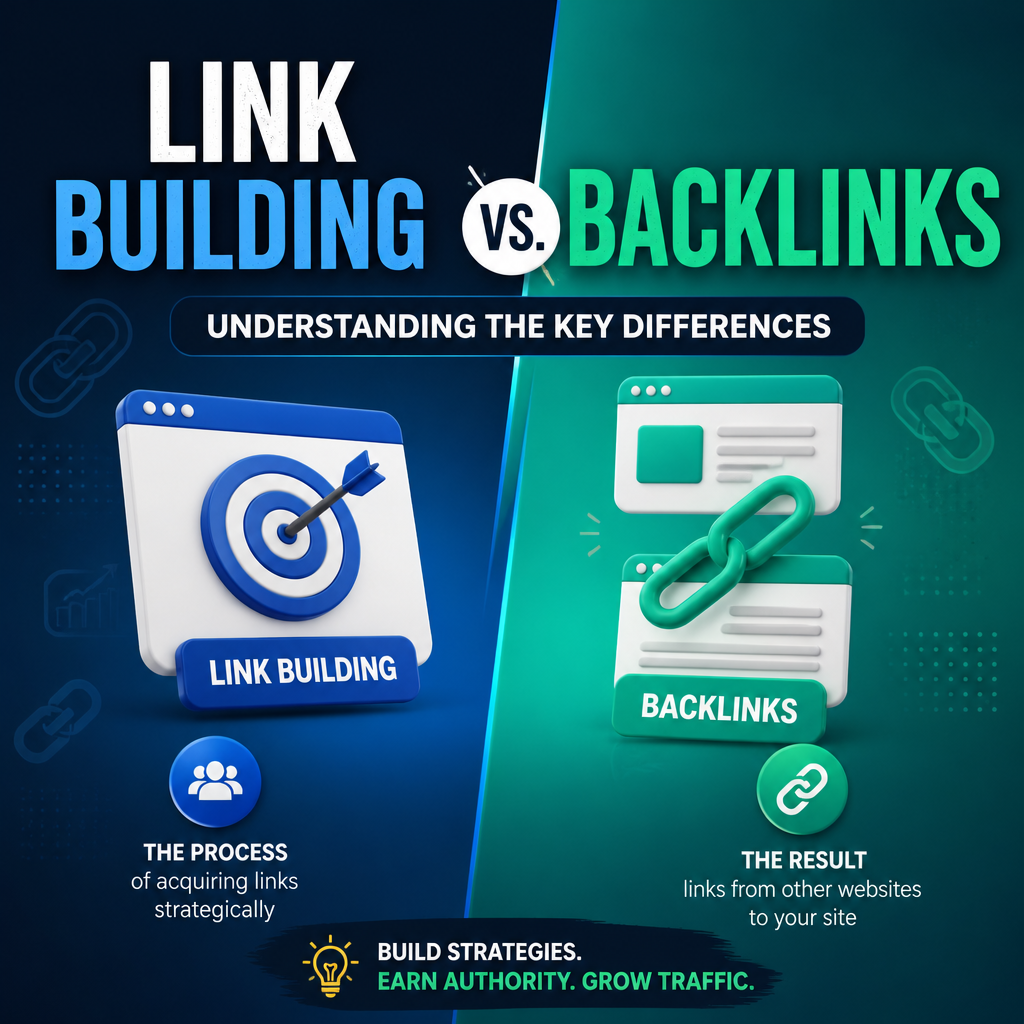
Link Building vs. Backlinks: Understanding the Key Differences
Link Building vs. Backlinks: Understanding the Difference
Search engine optimization includes many concepts that appear similar but describe very different things. “Link building” and “backlinks” are two of the most frequently confused terms.
They are closely connected, but they are not interchangeable:
- A backlink is a link from another website to your website.
- Link building is the process of earning, creating, or acquiring those links.
Understanding this distinction makes it easier to build a stronger SEO strategy, evaluate marketing results, and avoid tactics that could harm your website’s visibility. This guide explains how backlinks work, what link building involves, how the two concepts relate, and how to develop a sustainable approach.
What Is a Backlink?
A backlink is a hyperlink on one website that points to a page on another website. If a technology publication links to an article on your software company’s website, that link is a backlink for your site.
For example:
https://example.com/seo-guide
If this URL appears as a clickable link on another domain, your page has received a backlink.
Backlinks are also called:
- Inbound links
- Incoming links
- External links
- Inlinks
All of these terms generally refer to links that lead from an external website to your own.
A Simple Backlink Example
Suppose a food blogger publishes an article titled “Essential Kitchen Equipment for Beginners.” Within the article, the writer links to a cookware retailer’s guide about choosing pots and pans.
For the cookware retailer:
- The article is the referring page.
- The blogger’s domain is the referring domain.
- The link to the guide is a backlink.
- The retailer’s guide is the destination page.
The backlink exists regardless of how it was obtained. It may have been earned naturally, requested through outreach, included in a partnership, or created through another marketing activity.
Why Backlinks Matter for SEO
Search engines use links as one of many signals for discovering and evaluating content. A backlink can help in several ways.
1. Backlinks Help Search Engines Discover Pages
Search engine crawlers follow links to find new pages and understand how websites are connected. A link from an established website can help search engines discover a new page more efficiently.
This does not mean every backlink guarantees indexing or ranking. Search engines consider many other factors, including content quality, technical accessibility, relevance, and user experience.
2. Backlinks Can Pass Authority and Trust Signals
A link from a reputable website may indicate that the linked page is useful or credible. Historically, search engines have used link-based systems to estimate the importance of web pages.
However, the value of a backlink depends on more than the authority of the linking domain. Relevance, context, placement, and editorial quality also matter.
A link from a respected website in your industry is usually more meaningful than a link from an unrelated site with a large but low-quality link profile.
3. Backlinks Can Generate Referral Traffic
Backlinks are not useful only for rankings. A well-placed link can send interested visitors directly to your website.
For example, a link from a popular industry newsletter might bring fewer visitors than a high-traffic social platform, but those visitors may be more relevant and more likely to become customers.
Referral traffic can support:
- Brand awareness
- Lead generation
- Product discovery
- Newsletter subscriptions
- Sales and conversions
4. Backlinks Can Strengthen Brand Visibility
When your company is mentioned and linked across trusted websites, more people encounter your brand. Repeated exposure can improve recognition and reinforce your reputation in a particular field.
A backlink may therefore contribute value even when it does not produce a measurable ranking improvement.
What Is Link Building?
Link building is the planned process of obtaining backlinks from external websites. It includes the research, content creation, outreach, relationship development, promotion, and analysis required to earn or secure links.
In other words:
A backlink is the result. Link building is the activity used to achieve that result.
Link building can be proactive or passive.
- Proactive link building involves identifying opportunities, contacting website owners, promoting content, or contributing expertise.
- Passive link acquisition occurs when people discover valuable content and link to it without being asked.
A comprehensive SEO strategy usually combines both.
The Difference Between Link Building and Backlinks
The clearest way to understand the distinction is to compare them directly.
| Aspect | Backlinks | Link Building |
|---|---|---|
| Definition | Links from external websites to your site | The process of acquiring those links |
| Nature | An SEO asset or outcome | An SEO activity or strategy |
| Focus | What your website has received | What your team does |
| Measurement | Number, quality, relevance, and diversity of links | Campaigns, outreach, content, relationships, and results |
| Example | A newspaper links to your research report | You publish research and promote it to journalists |
A company may have thousands of backlinks but no active link-building program. Those links could have accumulated naturally over time.
Conversely, a company may run a link-building campaign without achieving meaningful results. Outreach may produce no responses, or the resulting links may be low quality and irrelevant.
This distinction is important because the number of link-building activities does not automatically determine the value of the backlink profile.
Not All Backlinks Are Equal
A common mistake is to evaluate backlinks by quantity alone. Ten relevant, editorially earned links can be more valuable than hundreds of unrelated or suspicious links.
Several factors influence backlink quality.
Relevance
A backlink is generally more useful when the linking website and destination page are related.
For example:
- A cycling publication linking to a bicycle maintenance guide is highly relevant.
- A real estate blog linking to an unrelated cryptocurrency page is less relevant.
- A link from a completely unrelated website may provide little meaningful value.
Relevance can exist at multiple levels:
- The entire domain may be relevant.
- The specific article may be relevant.
- The surrounding paragraph may provide topical context.
- The destination page may directly answer the reader’s needs.
Authority and Reputation
A link from a trusted website may carry more value than one from a new, poorly maintained, or low-quality domain.
Authority is not simply a matter of traffic or domain age. Consider:
- The quality of the site’s content
- Its editorial standards
- Its reputation within the industry
- Its own backlink profile
- Whether it attracts genuine users
- Whether it publishes useful, original information
Third-party metrics can help with research, but they should not replace human judgment.
Editorial Placement
Links placed naturally within useful editorial content are usually more credible than links hidden in unrelated directories, footers, or automatically generated pages.
For example, a paragraph that explains a concept and links to a detailed resource has a clear purpose. A page containing dozens of unrelated links may appear manipulative.
Anchor Text
Anchor text is the clickable wording of a link.
Examples include:
- “Read the complete technical SEO guide”
- “This project management template”
- “Visit the company website”
Descriptive anchor text helps users understand what they will find after clicking. It can also provide search engines with context.
However, repeatedly using exact-match commercial keywords can look unnatural. A healthy backlink profile typically includes a natural mix of:
- Branded anchor text
- URL-based anchors
- Descriptive phrases
- Partial-match terms
- Generic phrases such as “learn more”
- Occasionally, exact-match wording
The goal should be clarity and natural language rather than forced keyword placement.
Link Placement and Visibility
A link located within the main body of an article is generally more useful to readers than one buried in a footer or placed in a long list of unrelated links.
Visible, contextually relevant links are more likely to generate clicks and provide genuine value.
Follow and Nofollow Attributes
Links can include attributes that provide search engines with additional instructions.
Common attributes include:
rel="nofollow"rel="sponsored"rel="ugc"
A nofollow link tells search engines not to treat the link as a standard editorial endorsement in the same way as a conventional followed link. Sponsored links should be marked as sponsored, while links in user-generated content may use the ugc attribute.
These links can still generate referral traffic, exposure, and brand value. A nofollow or sponsored link is not automatically worthless.
Common Types of Backlinks
Backlinks can be categorized by how they are created and where they appear.
Editorial Backlinks
An editorial backlink is included naturally by a publisher because the linked content supports the article.
For example, a journalist may link to a company’s original research while explaining an industry trend. These links are often among the most valuable because they reflect an independent editorial decision.
Guest Contribution Links
A company or individual may contribute an article to another publication and include a relevant link to their website.
Guest contributions can be legitimate when they provide genuine expertise and useful information. Problems arise when the primary goal is to publish low-quality articles solely to insert links.
Resource Page Links
Some websites curate lists of useful tools, guides, organizations, or references. If your content genuinely meets the page’s criteria, you may request inclusion.
The strongest resource page opportunities are:
- Topically relevant
- Maintained regularly
- Selective about what they include
- Useful to a real audience
Business Profile Links
Business directories, professional associations, local listings, and industry profiles may link to a company’s website.
These links can support local visibility and help users find accurate business information. They are most useful when the listing is legitimate, relevant, and complete.
Digital Public Relations Links
Digital PR campaigns use newsworthy content, original data, expert commentary, or creative stories to attract media coverage.
A successful campaign may generate backlinks from:
- News publications
- Trade journals
- Industry blogs
- Local media
- Podcasts and event websites
The strongest PR links are earned because the story is genuinely interesting, timely, or useful.
User-Generated Links
Forums, community websites, review platforms, and comment sections may contain links to your website. These links can generate traffic and visibility when they are relevant and helpful.
Posting promotional links indiscriminately, however, can be considered spam and may damage your reputation.
Common Link-Building Strategies
Link building includes a wide range of tactics. The best approach depends on your industry, resources, audience, and content assets.
Create Link-Worthy Content
The foundation of many successful campaigns is content that people have a reason to reference.
Link-worthy content may include:
- Original research
- Industry surveys
- Detailed tutorials
- Statistical roundups
- Free tools and calculators
- Templates and checklists
- Expert interviews
- Visual explainers
- Case studies
- Definitive guides
A basic article can earn links if it provides an unusually clear answer or fills an important information gap. Content does not need to be complicated, but it should offer meaningful value.
Conduct Outreach
Outreach involves contacting relevant website owners, editors, journalists, or content creators to introduce a useful resource.
Effective outreach is:
- Personalized
- Concise
- Relevant
- Transparent
- Focused on the recipient’s audience
A weak outreach email might send the same generic message to hundreds of websites. A stronger email explains why the resource fits a specific article or audience.
Use Broken-Link Opportunities
Broken-link building involves finding outdated or nonfunctional links on relevant websites and suggesting an appropriate replacement.
For this method to work well:
- Identify a broken external link.
- Confirm that the page has a relevant topic and audience.
- Create or locate a useful replacement resource.
- Contact the site owner with accurate details.
- Explain the problem without pressuring the recipient.
The replacement should genuinely improve the page. Offering an irrelevant page simply because it creates a backlink is unlikely to succeed.
Reclaim Unlinked Mentions
A website may mention your company, product, research, or employees without linking to your site. These mentions can create straightforward opportunities.
A reclamation process may include:
- Monitoring brand mentions.
- Finding pages that mention your organization.
- Checking whether a link already exists.
- Contacting the publisher politely.
- Providing the most relevant URL.
Because the publisher has already referenced your brand, the request may be more successful than cold outreach.
Build Relationships With Industry Publishers
Long-term relationships with journalists, editors, bloggers, podcasters, and professional organizations can create recurring opportunities.
Relationship building should not be transactional. Helpful activities include:
- Sharing useful sources
- Providing timely expert commentary
- Attending industry events
- Contributing thoughtful insights
- Supporting relevant community initiatives
Trust makes future collaboration more natural and improves the quality of opportunities.
Promote Content Through Digital PR
Publishing a report is only the first step. Promotion can help it reach people who may reference it.
Promotion methods include:
- Sending a targeted media pitch
- Sharing findings with industry communities
- Offering expert commentary
- Creating concise visual summaries
- Publishing a press announcement when appropriate
- Connecting research to current events
The content must still be credible and useful. Promotion cannot compensate for weak evidence or an uninteresting topic.
Link-Building Tactics to Avoid
Some tactics may produce links quickly but create long-term risk.
Buying Links for Ranking Manipulation
Paying for links specifically to influence search rankings can violate search engine guidelines, especially when the links are not properly disclosed or are part of a manipulative scheme.
Paid advertising and sponsorships are legitimate when handled transparently and marked appropriately. The problem is using payment to disguise an editorial endorsement.
Excessive Link Exchanges
A reasonable partnership may involve linking to each other’s resources when appropriate. Large-scale, repetitive link exchanges designed primarily to manipulate rankings can appear artificial.
The question is whether the links make sense for users independently of SEO.
Private Blog Networks
Private blog networks are groups of websites created or controlled primarily to generate links. They often contain thin content, recycled articles, and unnatural linking patterns.
Although such networks may produce apparent short-term gains, they carry significant quality and penalty risks.
Automated Comment and Forum Spam
Posting the same promotional link across blogs, forums, or community websites is not sustainable link building. It can annoy users, damage brand trust, and result in links being removed or ignored.
Participate in communities to contribute useful answers, not simply to place URLs.
Low-Quality Directory Submissions
Not every directory is harmful. Legitimate local, professional, and industry directories can be useful. However, submitting a website to hundreds of low-quality directories adds little value and may create an unnatural link profile.
Private or Hidden Links
Hidden links, deceptive redirects, and links placed where users cannot reasonably see them are manipulative practices. They should not be used as part of a legitimate SEO strategy.
How to Evaluate a Link-Building Campaign
A link-building campaign should be assessed using more than the number of links acquired.
Measure Referring Domains
One website may link to your pages many times. Counting unique referring domains helps distinguish broad recognition from repeated links on a single site.
A campaign that earns links from several relevant domains may be more valuable than one that generates dozens of links from the same source.
Assess Link Quality
Review each acquired backlink for:
- Relevance
- Editorial context
- Website reputation
- Page quality
- Likely referral traffic
- Anchor text naturalness
- Placement
- Appropriate link attributes
A smaller number of strong links can represent a successful campaign.
Track Referral Traffic
Use analytics tools to determine whether backlinks send visitors. Look at:
- Sessions
- Engaged sessions
- Page views
- Conversions
- Assisted conversions
- Geographic location
- Device type
Traffic quality matters more than raw traffic volume. A link that sends 50 interested prospects may outperform one that sends 1,000 accidental visitors.
Monitor Rankings Carefully
Link building may support improved rankings, but ranking changes are influenced by many factors. Track relevant keywords over time while considering:
- Content updates
- Technical SEO changes
- Competitor activity
- Algorithm changes
- Seasonal trends
- Search intent shifts
Avoid assuming that every ranking increase or decline was caused by one specific backlink.
Evaluate Brand and Relationship Outcomes
A campaign may produce benefits that standard backlink tools do not capture, such as:
- Invitations to contribute to publications
- New partnerships
- Increased brand searches
- Speaking opportunities
- Press inquiries
- Industry recognition
These outcomes can be important indicators of a successful program.
How to Build a Sustainable Link-Building Process
A repeatable process helps ensure that link building supports broader marketing goals.
Step 1: Define the Audience and Objective
Decide whether the primary goal is:
- Improving visibility for a specific page
- Increasing referral traffic
- Building brand authority
- Supporting a product launch
- Promoting original research
- Strengthening local presence
Different goals call for different link-building methods.
Step 2: Audit Existing Backlinks
Review your current backlink profile to identify:
- Strong referring domains
- Important pages receiving links
- Broken destination URLs
- Unlinked brand mentions
- Suspicious or irrelevant patterns
- Gaps compared with competitors
An audit provides a baseline and prevents you from pursuing opportunities you already have.
Step 3: Identify Linkable Assets
Determine which pages or resources are most likely to earn links. Improve them before beginning outreach.
A linkable asset should be:
- Accurate
- Easy to understand
- Well organized
- Original or unusually useful
- Relevant to a defined audience
- Simple to reference
Step 4: Research Relevant Prospects
Build a prospect list based on topical relevance and audience fit, not just domain metrics.
Potential prospects include:
- Industry publications
- Professional associations
- Educational websites
- Local organizations
- Complementary businesses
- Journalists
- Bloggers
- Podcast hosts
- Resource curators
Step 5: Create Personalized Outreach
Explain the connection between your resource and the recipient’s content. Avoid exaggerated claims and generic language.
A useful outreach message should answer:
- Why are you contacting this person?
- What resource are you referencing?
- How does it help their audience?
- Where might the resource fit?
- What action are you requesting?
Step 6: Follow Up Respectfully
A single polite follow-up can be reasonable. Repeated messages, pressure, or aggressive language can harm relationships.
Remember that editors and publishers may have limited time, changing priorities, or policies against external links.
Step 7: Record and Review Results
Track prospects, responses, published links, referral traffic, and follow-up dates. Review which content types and outreach angles perform best.
Over time, this data can improve both efficiency and quality.
Are Backlinks Still Important?
Backlinks remain an important part of SEO, but they are not the only factor that determines search visibility.
Modern search systems evaluate many signals, including:
- Content usefulness
- Topical relevance
- Search intent
- Technical performance
- Page experience
- Website structure
- First-hand expertise
- Trustworthiness
- User behavior
- Brand recognition
A website with many backlinks but poor content may struggle to perform well. Likewise, a newer website with fewer backlinks can compete by publishing highly relevant, satisfying, and well-structured content.
The best way to view backlinks is as one part of a broader system. They can strengthen discovery, authority, and referral traffic, but they cannot replace a strong product, useful information, or a positive user experience.
Link Building vs. Backlinks: A Practical Example
Imagine an online accounting software company publishes a comprehensive guide to cash-flow forecasting.
The company then:
- Adds original examples and a downloadable spreadsheet.
- Promotes the guide to finance publications.
- Contacts educators who maintain small-business resource pages.
- Provides expert commentary to journalists covering cash-flow challenges.
- Shares the guide with relevant professional communities.
- Monitors mentions and requests links where the guide is referenced.
The links earned from these activities are backlinks.
The research, content development, outreach, promotion, and relationship-building activities are link building.
If a finance magazine independently discovers the guide and links to it without being contacted, that backlink is a form of natural link acquisition. The company may not have actively built that specific link, but its broader content strategy helped make the link possible.
Final Takeaway
Backlinks and link building describe two sides of the same SEO process.
A backlink is an incoming link from another website. Link building is the strategic work involved in earning or acquiring those links. Backlinks can support search discovery, authority, referral traffic, and brand visibility, while link building provides the methods used to generate those benefits.
The strongest approach focuses on relevance, quality, editorial value, and genuine usefulness. Instead of chasing the largest possible number of links, create resources worth referencing, build authentic relationships, and evaluate results based on both SEO performance and real business outcomes.
