
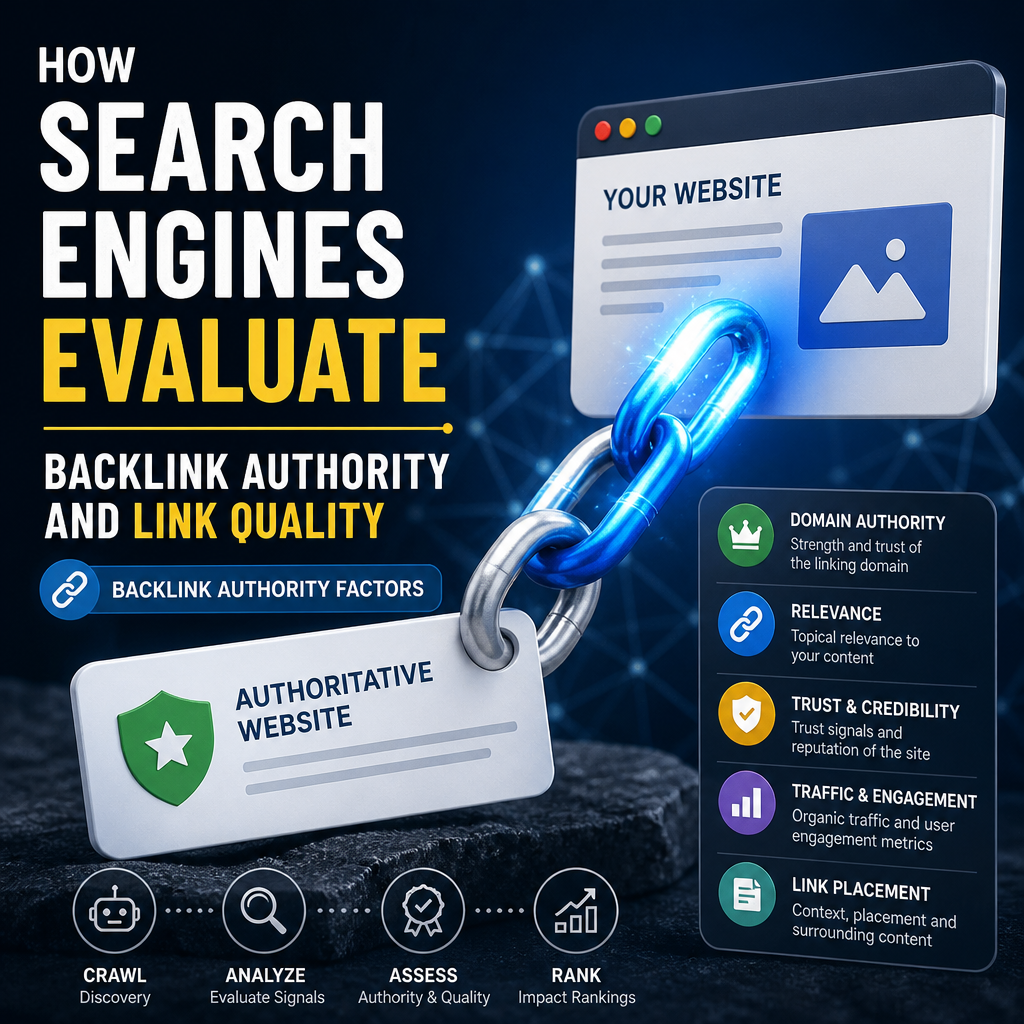
How Search Engines Evaluate Backlink Authority and Link Quality
How Search Engines Evaluate Backlink Authority
Backlinks remain one of the most important signals search engines use to understand the value, relevance, and credibility of web pages. A backlink is a link from one website to another, and search engines often interpret that link as a form of recommendation. However, not every backlink carries the same weight.
A link from a respected industry publication can contribute significantly more authority than dozens of links from unrelated, low-quality websites. Similarly, a contextual link within a detailed article may be more valuable than a link placed in a generic directory, footer, or author profile.
Understanding how search engines evaluate backlink authority helps website owners build stronger link profiles, prioritize effective outreach, and avoid tactics that may damage organic visibility. This article explains the main factors search engines consider, how those factors interact, and how to assess backlink quality in practical terms.
What Is Backlink Authority?
Backlink authority refers to the credibility and ranking influence that a link can potentially pass from one website or page to another. It is not a single, publicly visible score used uniformly by all search engines. Instead, it is a broad concept that includes several signals related to trust, relevance, quality, popularity, and editorial judgment.
When a search engine discovers a link, it may evaluate questions such as:
- Is the linking website trustworthy?
- Is the linking page relevant to the topic?
- Was the link placed naturally by an editor or site owner?
- Does the linking page receive genuine traffic and engagement?
- Is the link surrounded by useful, related content?
- Does the website have a history of publishing reliable information?
- Are there signs that the link was created solely to manipulate rankings?
The answers to these questions influence how much value the link may provide.
It is also important to distinguish between the authority of a domain and the authority of an individual page. A well-known website may publish a weak or irrelevant page, while a smaller website may create an exceptionally useful resource that earns strong links and visibility. Search engines can evaluate both the overall site and the specific page containing the backlink.
Why Backlinks Matter to Search Engines
Search engines originally used links as a way to discover new pages. Over time, links became an important method for estimating importance. The basic idea was that a link could act like a citation: when one page references another, it may indicate that the destination contains useful information.
Modern search engines use much more sophisticated systems than simple link counting. They analyze the quality and context of links, distinguish between natural and manipulative patterns, and combine link signals with content quality, user experience, relevance, and other ranking factors.
Backlinks can help search engines:
Discover new content
Search engine crawlers follow links to find pages that may not yet be included in the index.Understand relationships between topics
Links can reveal which pages, websites, and subjects are connected.Estimate reputation
A page that earns references from credible sources may deserve greater trust.Identify important pages within a site
Internal and external links can help search engines understand which pages are central to a website.Compare competing pages
When several pages cover a similar topic, authority signals may help determine which deserves greater visibility.
Backlinks are not a substitute for useful content. A page with many links but poor information may fail to rank well, while a high-quality page with fewer links can succeed when it satisfies search intent exceptionally well.
The Main Factors Used to Evaluate Backlink Authority
Authority of the Linking Website
The reputation of the linking website is one of the most obvious factors in backlink evaluation. A link from a trusted, established publication is generally more valuable than a link from a newly created website with little original content.
Search engines may consider signals such as:
- The quality of the site’s own backlink profile
- The consistency and depth of its content
- Its history and stability
- The expertise demonstrated by its authors
- Its reputation within a particular industry
- Whether it attracts genuine visitors and references
- Whether it participates in manipulative link schemes
For example, a backlink from a respected university, professional association, established news outlet, or recognized industry publication may carry strong contextual value. This does not mean every link from such a domain is automatically powerful. The specific page, placement, topic, and purpose still matter.
A prestigious domain can publish low-quality or irrelevant material, and search engines are capable of evaluating pages individually. Domain reputation helps establish a baseline, but it does not override other signals.
Authority of the Linking Page
The authority of the individual page containing the link can be just as important as the authority of the domain. A page that has earned many relevant, high-quality backlinks may pass more value than an isolated page on the same website.
Consider two pages on one publication:
- A well-researched industry report that has been cited by many specialists
- A short profile page with little original content and no external references
A backlink from the report is likely to be more meaningful because the page itself has stronger evidence of relevance and importance.
Page-level authority can be influenced by:
- The page’s inbound links
- Its content quality
- Its topical relevance
- Its organic visibility
- The number and quality of pages referencing it
- Its internal link position
- Its freshness, when current information matters
This is why evaluating only a website’s domain-level metrics can lead to inaccurate conclusions. A strong domain does not make every page equally authoritative.
Topical Relevance
Relevance is a central part of backlink authority. A link is more useful when it comes from content related to the subject of the destination page.
Imagine a website about home renovation receiving a link from an article about kitchen design. That link is naturally relevant. A link from a page about marine biology would be much harder to interpret as a meaningful editorial recommendation, even if the marine biology website itself is reputable.
Topical relevance can exist at several levels:
- Industry relevance: The websites operate in related fields.
- Page relevance: The linking page discusses a related subject.
- Contextual relevance: The surrounding paragraph naturally supports the destination.
- Audience relevance: Readers of the linking page would reasonably benefit from the linked resource.
Relevance does not require an exact keyword match. A financial planning article might naturally link to a page about retirement calculators without using identical terminology. Search engines increasingly interpret meaning, entities, and topics rather than relying only on exact words.
A relevant link can reinforce how search engines classify the destination page. For example, multiple editorial references from pages discussing technical project management may help clarify that a linked resource is specifically about project management software for development teams.
Editorial Placement
Search engines tend to value links that appear to have been placed editorially. An editorial link is one included because the publisher believes it improves the content or helps readers.
Strong editorial placements often appear:
- Within the main body of an article
- In a relevant explanation or example
- As a citation for a claim
- In a curated list of valuable resources
- Within original research or industry commentary
By contrast, links placed in areas designed primarily for promotion may carry less authority. Examples include:
- Sitewide footer links
- Generic sidebar links
- Large blogrolls
- Unmoderated comment sections
- Automatically generated profile pages
- Pages containing excessive unrelated links
Placement alone does not determine value. A resource page or directory can be useful when it is carefully curated and relevant. The key question is whether the link serves a genuine editorial or user-focused purpose.
Context Surrounding the Link
The words and information surrounding a backlink help search engines understand why the link exists. A link embedded in a clear, informative paragraph is easier to interpret than one placed beside unrelated promotional text.
Suppose an article states:
Organizations comparing customer support platforms can review this detailed guide to ticketing system features and implementation costs.
The linked destination is supported by the surrounding context. Readers understand what they will find, and search engines can identify the relationship between the two pages.
Useful contextual signals include:
- The topic of the paragraph
- The claims made before and after the link
- Related terminology
- The purpose of the destination page
- The likely needs of the audience
- Whether the link contributes to a complete explanation
Context also protects against misleading associations. A link may use appropriate anchor text but still be weak if it appears in a paragraph with no meaningful relationship to the destination.
Anchor Text
Anchor text is the clickable wording used in a backlink. It provides information about the linked page and can influence how search engines interpret its subject.
Common types of anchor text include:
- Branded: “Northwind Analytics”
- Exact match: “technical SEO audit”
- Partial match: “our guide to SEO audits”
- Descriptive: “a checklist for evaluating website performance”
- Generic: “click here” or “learn more”
- Naked URL: “example.com”
Natural backlink profiles usually contain a varied mixture of these types. Excessive use of exact-match commercial phrases may suggest that links were deliberately built to manipulate rankings. This is especially concerning when many links come from low-quality or unrelated websites.
The best anchor text is usually concise, accurate, and helpful to readers. It should describe the destination without appearing forced. Website owners generally have limited control over how other publishers link to them, so a varied anchor profile is normal and often desirable.
Link Position and Visibility
A link’s location on a page can influence how search engines interpret its importance. Links in the main content are typically more meaningful than links repeated across every page template.
A backlink near the beginning of a relevant article may receive more attention than one buried in a long list of unrelated links. However, visibility should not be confused with authority. A prominent link can still be low quality if the page is untrustworthy or irrelevant.
Search engines may examine:
- Whether the link appears in the primary content
- Its location within the page
- The amount of surrounding text
- Whether the link is repeated sitewide
- Whether users can reasonably see and use it
- Whether the placement appears natural
A link should be placed where it helps readers continue their research. This user-centered principle generally aligns with how search engines evaluate natural links.
The Linking Site’s Link Profile
The authority of a website is partly shaped by the links it has earned from other sites. A website referenced by respected, relevant sources may have stronger credibility than a website whose links primarily come from low-quality networks.
Search engines may identify patterns such as:
- Links from authoritative publications
- References from organizations within the same industry
- Natural growth over time
- A wide variety of referring domains
- Excessive links from known spam sources
- Paid or reciprocal linking patterns
- Unnatural surges in exact-match anchor text
A site’s link profile is not evaluated by raw quantity alone. One hundred low-quality links may contribute less than a handful of strong references. In some cases, manipulative links can create risk rather than authority.
Trust and Spam Signals
Search engines use systems designed to identify spam, deception, and attempts to manipulate rankings. Backlinks may be discounted when they show characteristics associated with artificial link building.
Potential warning signs include:
- Large numbers of links appearing suddenly without a clear reason
- Links from unrelated websites
- Repeated exact-match anchor text
- Private networks created primarily for ranking manipulation
- Paid links that are not properly identified
- Content created solely to host links
- Automated directory or bookmark links
- Links hidden from users
- Excessive reciprocal linking
- Pages with spun, duplicated, or extremely thin content
A single questionable backlink is rarely catastrophic. Search engines understand that website owners cannot control every link pointing to them. Problems are more likely when a site has a broad, repeated pattern of manipulative activity.
The safest approach is to earn links through valuable content, useful tools, original research, expert commentary, partnerships, and genuine relationships within an industry.
Link Attributes
Some links include attributes that provide search engines with additional information about their purpose.
The most common attributes are:
rel="nofollow"rel="sponsored"rel="ugc"
A nofollow attribute indicates that the publisher does not want the link treated as a typical editorial endorsement. A sponsored attribute identifies paid or promotional placements. A ugc attribute identifies user-generated content, such as forum posts or comments.
These attributes do not necessarily mean a link has no value. Search engines may still use such links for discovery, context, or other purposes. However, they provide important signals about how the link should be interpreted.
Paid links should be disclosed appropriately. Failing to identify commercial relationships can create both search and regulatory concerns.
Link Uniqueness and Referring Domain Diversity
A backlink from a new referring domain may provide more incremental value than many additional links from the same website. For example, ten links from ten respected, relevant websites may demonstrate broader recognition than ten links from one domain.
This does not make multiple links from one site useless. Additional links can:
- Send referral traffic
- Help users discover related content
- Strengthen topical associations
- Support new pages
- Provide repeated exposure to a relevant audience
However, a diverse set of genuine referring domains often provides stronger evidence that a resource is broadly recognized. Quality and relevance remain more important than pursuing a specific number of domains.
Freshness and Timeliness
For topics that change frequently, recent references may be especially meaningful. A backlink from an up-to-date article about current regulations, software, market conditions, or security practices can provide stronger contextual value than a link from an outdated page.
Freshness is not equally important for every topic. A historical reference or evergreen academic resource may remain valuable for many years. Search engines consider the subject and intent of the query when evaluating the importance of current information.
Updating the destination page can also help maintain its usefulness. When a resource remains accurate, publishers are more likely to continue citing it.
How Search Engines Distinguish Authority From Link Quantity
A common misunderstanding is that the website with the most backlinks should rank first. In practice, search engines attempt to estimate the quality and meaning of those links.
A large link count may be misleading because:
- Many links may come from the same domain
- Some links may be nofollowed or otherwise qualified
- Links may appear on low-quality pages
- The websites may have little topical relevance
- Links may be sitewide or automated
- The links may be duplicates across syndicated content
- Some may be ignored as spam
By contrast, a smaller number of strong links can demonstrate meaningful recognition. Consider two competing pages about employee onboarding:
- Page A has 2,000 links from unrelated directories and low-quality blogs.
- Page B has 25 links from human resources associations, respected business publications, and software comparison sites.
Page B may have the stronger backlink profile because its links are more relevant, editorially placed, and trustworthy.
A Practical Framework for Evaluating a Backlink
Website owners can assess potential backlinks by reviewing several questions.
1. Is the Website Credible?
Look at the site’s content, history, authorship, reputation, and overall quality. Avoid judging it by a single third-party metric.
2. Is the Page Relevant?
Read the actual page containing the link. Does it discuss a topic related to the destination, or is the link disconnected from the content?
3. Is the Link Editorial?
Ask whether the publisher would have included the link if ranking benefits did not exist. A genuine reference is generally safer and more valuable than a paid or automated placement.
4. Is the Link Visible and Useful?
The link should be accessible to users and placed where it supports the reader’s next step.
5. Is the Anchor Text Natural?
The wording should accurately describe the destination and fit smoothly into the sentence.
6. Does the Site Attract a Real Audience?
A website with genuine readers may provide referral traffic and stronger evidence of legitimacy, even when its domain-level metrics are modest.
7. Are There Spam Patterns?
Review the site for excessive advertising, copied content, unrelated outbound links, or obvious attempts to sell links at scale.
A simple evaluation table can help:
| Factor | Strong Signal | Weak Signal |
|---|---|---|
| Relevance | Closely related topic | Unrelated subject |
| Placement | Main editorial content | Footer or automated block |
| Anchor text | Natural and descriptive | Repeated exact-match phrase |
| Website quality | Original, trusted content | Thin or copied pages |
| Audience | Genuine readership | No clear users or engagement |
| Link purpose | Useful reference | Purely promotional placement |
Common Misconceptions About Backlink Authority
“More Links Always Mean More Authority”
Quantity is only one surface-level measurement. Search engines evaluate quality, relevance, and patterns. A large collection of weak links can be ignored or become a liability.
“A High Domain Score Guarantees a Valuable Link”
Third-party tools use their own formulas and databases. Their scores can be useful for comparison, but they are not search engine rankings and should not be treated as definitive proof of authority.
“Every Link From a Major Website Is Powerful”
Large websites contain strong pages, weak pages, user-generated areas, sponsored content, and irrelevant sections. The specific placement matters.
“Nofollow Links Are Completely Worthless”
A nofollow link may still generate referral traffic, increase visibility, assist discovery, and lead to additional editorial links. It simply sends a different signal regarding endorsement.
“Exact-Match Anchor Text Is Always Best”
Over-optimized anchor text can look unnatural. Descriptive, varied language usually creates a healthier link profile.
“A Link Is Valuable Only If It Passes Ranking Signals”
Links can provide value through brand exposure, qualified visitors, partnerships, conversions, and content discovery. SEO is important, but referral traffic and reputation also matter.
How to Earn High-Authority Backlinks
The most sustainable link-building strategies focus on creating something worth referencing.
Publish Original Research
Surveys, industry studies, benchmark reports, and data analyses can attract citations because other publishers need credible evidence for their own content.
Create Practical Resources
Checklists, templates, calculators, glossaries, tutorials, and comparison guides are often useful enough to earn natural references.
Develop Expert-Level Content
Detailed articles should explain a subject clearly, include examples, acknowledge limitations, and offer information that is more useful than competing pages.
Build Relationships With Relevant Publishers
Contributing thoughtful commentary, participating in industry discussions, and developing professional relationships can create legitimate opportunities for coverage.
Promote Useful Content
Even excellent content may remain unnoticed without distribution. Share resources with relevant communities, contact publishers who cover the topic, and make it easy for readers to understand the resource’s value.
Improve Existing Assets
Updating outdated statistics, expanding incomplete guides, and fixing broken resources can make a page more worthy of citation.
Use Digital Public Relations
Newsworthy announcements, expert opinions, original findings, and timely industry analysis can attract editorial coverage from reputable publications.
The central principle is simple: build assets that publishers and readers would want to reference even without an explicit ranking benefit.
How to Monitor Backlink Authority Over Time
Backlink evaluation should be an ongoing process rather than a one-time audit. Monitor:
- New referring domains
- Lost backlinks
- Changes in anchor text
- Links from relevant industries
- Referral traffic
- Pages earning the most links
- Sudden growth in low-quality links
- Links pointing to outdated or redirected pages
A strong backlink profile should develop naturally and support the site’s content strategy. When a valuable backlink points to a page that has moved, a redirect or outreach message may help preserve the relationship.
Do not panic over every unfamiliar or low-quality link. Many websites accumulate links they did not request. Focus on patterns, especially when suspicious links appear in large numbers or alongside other signs of manipulation.
The Role of User Value
Although backlinks are evaluated as technical signals, their underlying purpose is connected to users. A useful link helps people discover information, verify a claim, compare options, or continue researching a subject.
This provides a practical test for backlink quality:
Would a real reader benefit from clicking this link?
If the answer is yes, the link is more likely to be relevant, natural, and defensible. If the link exists only to influence rankings and provides no meaningful value, it may be ignored or treated as manipulative.
Conclusion
Search engines evaluate backlink authority through a combination of signals rather than a simple link count. The credibility of the linking website, authority of the specific page, topical relevance, editorial placement, surrounding context, anchor text, link attributes, trust signals, and referring-domain diversity all contribute to how a backlink may be interpreted.
The strongest backlinks are usually earned rather than manufactured. They come from relevant pages, appear naturally within useful content, and help readers find additional information. Building this kind of link profile requires patience, original resources, sound promotion, and a consistent focus on quality.
Instead of asking how many backlinks a website has, ask what those links represent. Do they demonstrate genuine recognition from relevant sources? Do they help users? Do they fit naturally within the broader web? Those questions provide a more accurate foundation for understanding backlink authority and building long-term search visibility.
