
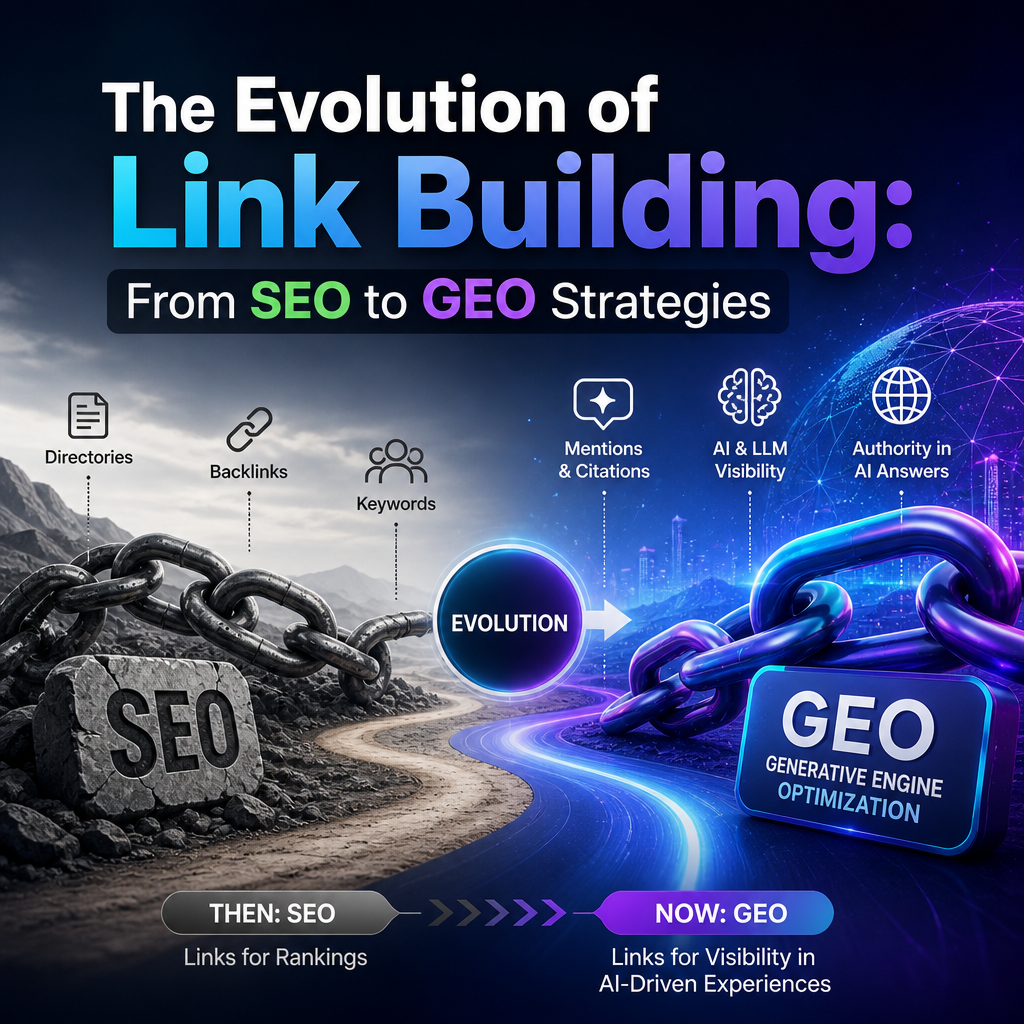
The Evolution of Link Building: From SEO to GEO Strategies
The Evolution of Link Building: From SEO to GEO
Link building has always been one of the most influential—and misunderstood—parts of digital marketing. What began as a relatively simple measure of website popularity has evolved into a sophisticated discipline involving reputation, relevance, relationships, data, content quality, and machine interpretation.
For years, search engine optimization (SEO) professionals focused on earning backlinks to improve rankings in traditional search results. A link from one website to another acted as a vote of confidence, helping search engines discover pages and determine which content deserved visibility.
Today, the search landscape is changing again. Artificial intelligence systems, answer engines, conversational interfaces, and generative search experiences are reshaping how people find and evaluate information. In this new environment, link building is not only about ranking a webpage. It is also about making a brand, organization, or source recognizable, verifiable, and citable across AI-powered discovery systems.
This shift has given rise to a broader concept: GEO, or Generative Engine Optimization. While SEO remains essential, GEO expands the goal from appearing in a list of search results to becoming part of the answers generated by AI systems.
The evolution from SEO to GEO does not make traditional link building obsolete. Instead, it changes how links should be earned, evaluated, and connected to a broader digital authority strategy.
What Link Building Originally Meant
In its earliest form, link building was closely tied to the structure of the web itself. Search engines used links to crawl and index pages. A link helped a search engine discover content and understand how different websites were connected.
Google changed the importance of links with the introduction of PageRank. Rather than treating every webpage equally, PageRank evaluated links as signals of authority. A link from a trusted, established website carried more weight than a link from an obscure or low-quality page.
This created a straightforward principle:
The more credible websites that link to a page, the more likely that page is to be considered authoritative.
That principle quickly became central to SEO. Businesses began seeking links from industry publications, directories, blogs, resource pages, and partner websites. Some strategies were legitimate and useful. Others attempted to manipulate rankings through large-scale link exchanges, paid placements, automated comments, and private blog networks.
As search engines improved, they became better at distinguishing meaningful recommendations from artificial attempts to influence rankings.
The Early Era: Quantity Over Quality
During the early and mid-2000s, link building was often measured by volume. Marketers asked questions such as:
- How many backlinks does a website have?
- How quickly can a domain acquire new links?
- How many directories can be submitted?
- How many anchor-text variations can be created?
- How can a site gain links at scale?
This era produced several tactics that are now considered risky or ineffective:
- Automated directory submissions
- Blog comment spam
- Article spinning
- Reciprocal link networks
- Exact-match anchor-text campaigns
- Paid links designed to pass ranking value
- Large-scale guest posting with little editorial oversight
- Links from unrelated websites
- Private blog networks created solely for manipulation
These tactics sometimes worked in the short term because search engines had fewer systems for evaluating context, intent, and quality. However, they also created a poor experience for users and weakened the reliability of search results.
The fundamental flaw was that marketers treated links as isolated units rather than as editorial signals embedded in meaningful content.
The Shift Toward Quality and Relevance
Search engine updates gradually changed the economics of link building. Google’s Penguin update, along with other quality-focused improvements, increased scrutiny of manipulative backlink profiles and unnatural anchor-text patterns.
The industry began moving away from “build as many links as possible” toward a more nuanced approach:
- Is the linking website trustworthy?
- Is the page relevant to the linked content?
- Does the link appear naturally within an editorial context?
- Would a human reader find the link useful?
- Does the linking website have a real audience?
- Is the anchor text descriptive rather than manipulative?
- Does the link support a broader topic or entity relationship?
This transition made content marketing, digital PR, expert commentary, original research, and relationship-based outreach more important.
A link earned from a respected publication in the same industry could be more valuable than hundreds of unrelated links. The value of a backlink was no longer determined only by its existence. It depended on context.
Why Relevance Became a Core Link-Building Signal
Relevance helps search engines understand the subject matter of both the linking page and the destination page. It also helps users decide whether a link deserves attention.
Consider two examples:
- A cybersecurity company receives a link from a respected technology publication discussing data breaches.
- The same company receives a link from an unrelated website about home gardening.
Both links may technically point to the cybersecurity company, but they do not carry the same meaning. The first reinforces the company’s expertise in cybersecurity. The second may look artificial or irrelevant.
Relevance can operate at multiple levels:
Topical Relevance
The linking website covers a subject related to the destination website.
Page-Level Relevance
The specific article containing the link discusses a topic connected to the linked page.
Audience Relevance
The linking website’s readers are likely to benefit from the destination resource.
Geographic Relevance
A local business may gain value from links on regional publications, local organizations, chambers of commerce, or community websites.
Entity Relevance
The link helps connect a brand, person, product, or organization with a recognized topic or category.
These layers of relevance have become increasingly important as search engines move beyond keyword matching and toward semantic understanding.
From Keywords to Entities
Traditional SEO often focused heavily on keywords. Marketers optimized pages for phrases such as “best project management software” or “commercial solar installation.”
Modern search systems also examine entities: people, companies, products, locations, concepts, organizations, and relationships between them.
A backlink can help establish these relationships. For example:
- A university links to a research organization’s study.
- An industry association lists a company as a certified member.
- A news publication cites an executive as an expert.
- A government website references a nonprofit’s public resource.
- A software review site connects a product with a particular use case.
In each situation, the link does more than transfer authority. It contributes to the web’s understanding of who an entity is, what it does, and where it fits within a broader field.
This entity-based perspective is especially important for GEO because generative systems need to identify reliable sources and interpret relationships between concepts.
What Is Generative Engine Optimization?
Generative Engine Optimization refers to the process of improving a brand’s visibility and representation within AI-generated answers.
Traditional search typically presents a ranked page of results. A user chooses among titles, descriptions, maps, videos, and other features. A generative engine may instead synthesize information from multiple sources and provide a direct response.
Examples include:
- AI-powered search summaries
- Conversational search assistants
- Enterprise knowledge assistants
- Chat-based recommendation tools
- Voice interfaces
- Specialized answer engines
- AI systems that summarize products, services, or research
GEO focuses on helping these systems recognize a source as relevant, credible, and useful enough to include or cite.
This does not mean that marketers can control exactly what an AI system says. Generative outputs are probabilistic and may vary by prompt, user context, location, and system design. However, brands can improve their chances of being represented accurately by building a strong, consistent, and well-supported digital presence.
How Link Building Supports GEO
Links remain valuable in a generative search environment because they help create a network of evidence.
A generative system may evaluate information using multiple signals, including:
- Website content
- Structured data
- Public mentions
- Citations
- Author credentials
- Third-party reviews
- Industry references
- Organizational relationships
- Cross-platform consistency
- Links from trusted sources
A backlink from a credible source can help validate a claim, strengthen an entity association, or demonstrate that a website is recognized within a particular field.
For example, suppose an AI system receives a question about a company’s expertise in sustainable packaging. The company is more likely to be understood as authoritative if:
- Its website publishes detailed research about sustainable packaging.
- Trade publications cite its experts.
- Industry associations list the company as a member.
- Universities or research groups reference its findings.
- Customers and reviewers describe its products consistently.
- Independent sources link to its educational resources.
In this situation, link building is part of a broader credibility ecosystem.
The Difference Between SEO Link Building and GEO-Oriented Link Building
SEO link building and GEO-oriented link building share many principles, but their objectives are not identical.
SEO-Oriented Link Building
The primary objectives are to:
- Improve organic rankings
- Increase referral traffic
- Help search engines discover content
- Strengthen domain authority
- Support target pages
- Build topical relevance
GEO-Oriented Link Building
The objectives expand to include:
- Make an organization recognizable as an entity
- Reinforce relationships between brands and topics
- Provide evidence for important claims
- Increase the likelihood of being cited in AI-generated answers
- Improve consistency across authoritative sources
- Establish expertise beyond a single website
- Make information easier for machines to verify and summarize
SEO often asks, “How can this page rank higher?”
GEO also asks, “How can this brand become a trusted source within the answer ecosystem?”
The Rise of Digital PR as Modern Link Building
Digital PR has become one of the most effective ways to earn high-quality links because it combines newsworthiness, expertise, and editorial relevance.
Instead of asking websites to add a link, digital PR creates stories and resources that publishers want to reference.
Effective digital PR assets may include:
- Original surveys
- Industry reports
- Proprietary data
- Expert commentary
- News analysis
- Public-interest research
- Interactive tools
- Consumer trend studies
- Investigative resources
- Expert-led predictions
- Visualized datasets
For example, a financial company could publish a report analyzing regional changes in household spending. Journalists, economists, local publications, and industry analysts may cite the findings. Each citation creates not only a backlink but also an association between the company and financial expertise.
This type of earned media is particularly valuable for GEO because it gives AI systems more independent sources from which to learn about a brand.
Content Worth Linking to
Link building cannot be separated from the quality of the destination content. A website may earn a link through a news story, but if the linked page is thin, vague, or promotional, it may not support long-term authority.
Link-worthy content usually provides one or more of the following:
Original Information
New data, research, surveys, or observations are naturally valuable because other publishers cannot find them elsewhere.
Practical Utility
Templates, calculators, checklists, guides, and tools can attract links because they solve real problems.
Clear Expertise
Detailed explanations supported by credible authorship and evidence can become reference material for an industry.
Strong Organization
Well-structured pages are easier for readers, crawlers, and AI systems to interpret.
Timely Analysis
A thoughtful response to a major event or industry development can attract citations while the topic is receiving attention.
Comprehensive Coverage
A resource that explains a complex subject thoroughly may become a destination for future references.
A useful content asset should answer a simple question: Why would another publisher or expert want to cite this page?
Building Links Through First-Hand Expertise
AI-generated content has increased the importance of first-hand experience. Many websites now publish generic articles that repeat information already available elsewhere. These pages may target keywords, but they offer little unique value.
First-hand expertise can make content more linkable and more useful to generative systems. It may come from:
- Original case studies
- Documented experiments
- Customer research
- Professional interviews
- Behind-the-scenes process details
- Expert opinions supported by experience
- Before-and-after results
- Internal benchmarks
- Lessons from failed campaigns
- Industry-specific examples
For instance, a logistics company could publish a detailed analysis of how it reduced delivery delays across different regions. This offers more value than a general article about “ways to improve logistics.”
First-hand information is difficult to replicate and gives other sources a reason to reference the original publisher.
The Importance of Author and Brand Credibility
Links do not operate independently of the people and organizations behind them. Search engines and AI systems increasingly evaluate authorship, expertise, and reputation.
A strong link-building strategy should support credibility at three levels:
Individual Expertise
Are the authors qualified to discuss the subject? Do they have relevant experience, credentials, publications, or professional recognition?
Organizational Expertise
Does the company or institution have a legitimate connection to the topic? Does it publish consistently and demonstrate knowledge over time?
Third-Party Validation
Do respected independent sources confirm the organization’s expertise?
A backlink from a trusted publication can help validate a brand, but it is even more effective when the brand’s website clearly explains who created the content and why that person is qualified to write it.
Link Attributes and Their Evolving Role
Not every link passes traditional ranking value, but that does not make every non-followed link useless.
Common link attributes include:
rel="nofollow"rel="sponsored"rel="ugc"
These attributes help search engines understand the nature of a link. A sponsored link identifies paid placement. A user-generated content link may come from a forum or comment section. A nofollow link signals that the publisher does not necessarily endorse the destination for ranking purposes.
Even when a link does not pass conventional authority, it may still provide:
- Referral traffic
- Brand exposure
- Entity recognition
- Public validation
- Content discovery
- Journalistic visibility
- Opportunities for secondary citations
In a GEO environment, the broader context of a mention may matter alongside the technical link attribute. A respected publication discussing a brand can contribute to recognition even if the link is marked nofollow.
The Decline of Exact-Match Anchor Text
Exact-match anchor text was once a common tactic. If a website wanted to rank for “best accounting software,” it might attempt to acquire many links using that exact phrase.
This approach can create an unnatural backlink profile and may signal manipulation. Natural links typically use a variety of anchor styles, including:
- Brand names
- Page titles
- Descriptive phrases
- URLs
- Generic terms such as “this guide”
- Partial keyword references
- Sentence-based contextual anchors
For example, these anchors may all be natural ways to reference the same resource:
- “Acme Research”
- “the 2025 consumer spending report”
- “this analysis of household budgets”
- “read the full study”
- “acmeexample.com/research”
A healthy link profile usually reflects how real people write. The goal should be to make the link useful and descriptive, not to force a ranking phrase into every reference.
Digital Ecosystems and Multi-Source Consistency
Generative systems often rely on information distributed across the web. A brand’s credibility can be weakened when its details differ from source to source.
Important information to keep consistent includes:
- Official business name
- Founding date
- Leadership
- Products and services
- Locations
- Industry categories
- Contact information
- Areas of expertise
- Professional credentials
- Partnerships
- Awards and certifications
This does not mean every profile should use identical wording. It means core facts should be accurate and aligned.
Links from industry directories, associations, media profiles, partner websites, conference pages, and professional organizations can help create a consistent entity footprint.
The objective is not to place the same information everywhere. It is to ensure that credible sources reinforce the same underlying identity.
What Makes a Link Valuable in the GEO Era?
A useful framework for evaluating a link includes five questions:
1. Is the Source Trustworthy?
Consider the publication’s editorial standards, history, audience, authorship, and reputation.
2. Is the Context Relevant?
The article and surrounding discussion should connect naturally to the destination page.
3. Does the Link Support a Meaningful Relationship?
The link should help explain how the brand relates to a topic, audience, product, or area of expertise.
4. Is the Destination Page Strong?
The linked content should be accurate, useful, accessible, and worthy of reference.
5. Would the Link Matter Without SEO?
If the link could generate qualified traffic, strengthen reputation, or help a reader, it is more likely to be valuable in the long term.
This final question is particularly important. Links that exist only to influence algorithms are vulnerable to algorithm changes. Links that serve users and reflect genuine editorial judgment tend to remain useful.
Common Link-Building Mistakes to Avoid
Pursuing Volume Without Context
A large number of irrelevant links can create noise rather than authority.
Publishing Generic Guest Posts
Guest content should provide real value to the host publication. Thin, repetitive articles written only to place links are unlikely to build lasting credibility.
Ignoring Brand Mentions
Unlinked mentions can still create awareness, but brands should identify opportunities to turn important references into useful citations when appropriate.
Over-Optimizing Anchor Text
Natural language and brand-based anchors are generally safer and more believable than aggressive exact-match patterns.
Neglecting Internal Links
Internal linking helps users and search systems understand relationships among a website’s own pages. It also helps distribute attention toward important resources.
Relying on One Outreach Channel
A resilient strategy may combine editorial outreach, partnerships, digital PR, expert contributions, community participation, events, research, and content promotion.
Measuring Only Domain Metrics
Third-party authority scores can be useful for comparison, but they are not the same as business value, editorial quality, or AI visibility.
How to Measure Link Building Beyond Rankings
Traditional rankings remain important, but a broader measurement framework is needed.
Useful metrics include:
- Organic traffic to linked pages
- Referral traffic
- Qualified leads
- Assisted conversions
- Brand search growth
- Number of referring domains
- Growth in relevant citations
- Mentions in industry publications
- Visibility for branded and nonbranded searches
- Inclusion in AI-generated answers
- Accuracy of AI-generated brand descriptions
- Engagement from earned media
- Growth in partnerships and invitations
For GEO, measurement is still developing. Marketers may monitor how often a brand appears in answers to relevant prompts, which sources are cited, and whether the information presented is accurate.
Because generative outputs vary, GEO measurement should be treated as directional rather than absolute. A single answer does not define visibility. Patterns across prompts, platforms, locations, and time provide more useful insight.
A Practical Link-Building Strategy for SEO and GEO
A modern strategy can be organized into several steps.
Step 1: Define the Expertise You Want to Own
Identify the subjects, problems, and categories most closely connected to the organization’s value.
Step 2: Audit Existing Authority
Review current backlinks, brand mentions, content assets, author profiles, business listings, and third-party references.
Step 3: Identify Evidence Gaps
Determine which important claims lack independent support. For example, a company may claim expertise in a field but have few credible sources confirming it.
Step 4: Create Original Assets
Develop research, tools, case studies, guides, or expert resources that deserve citation.
Step 5: Build Relevant Relationships
Connect with journalists, editors, researchers, associations, conference organizers, partners, and subject-matter communities.
Step 6: Promote with Context
Outreach should explain why a resource is useful to a specific audience. Generic mass emails are less effective than personalized, relevant communication.
Step 7: Strengthen Internal Architecture
Use descriptive internal links to connect related pages and make important resources easy to find.
Step 8: Improve Entity Consistency
Ensure that authoritative external profiles describe the organization accurately and consistently.
Step 9: Monitor Results
Track links, mentions, referrals, rankings, brand searches, conversions, and appearances within generative answers.
Step 10: Refresh and Maintain
Update research, correct outdated claims, preserve valuable links, and continue contributing expertise to the industry.
The Future of Link Building
Link building is unlikely to disappear because the web still depends on connections between sources. What is changing is the meaning of those connections.
Future search systems may place greater emphasis on:
- Provenance
- Citation quality
- Author expertise
- First-party evidence
- Consensus across trusted sources
- Entity relationships
- Content freshness
- User satisfaction
- Cross-platform reputation
- Machine-readable structure
This may reduce the value of isolated, low-context links and increase the importance of links embedded in credible knowledge networks.
The best link builders will increasingly resemble researchers, public relations professionals, editors, analysts, and subject-matter strategists. Their work will involve creating evidence, developing relationships, clarifying expertise, and helping information travel through trusted channels.
Conclusion
The evolution of link building from SEO to GEO reflects a broader transformation in how online authority is established.
Links began as pathways for discovery and ranking signals. Over time, they became indicators of relevance, editorial trust, expertise, and reputation. In the age of generative search, they also help AI systems understand entities, verify claims, and identify sources worth citing.
The most effective strategy is not to chase links as isolated ranking assets. It is to build a credible digital ecosystem around valuable content, recognized expertise, accurate information, and genuine relationships.
Traditional SEO still matters. But the future belongs to organizations that do more than rank pages. They become trusted sources that search engines, publishers, users, and generative systems can confidently recognize, understand, and reference.
