
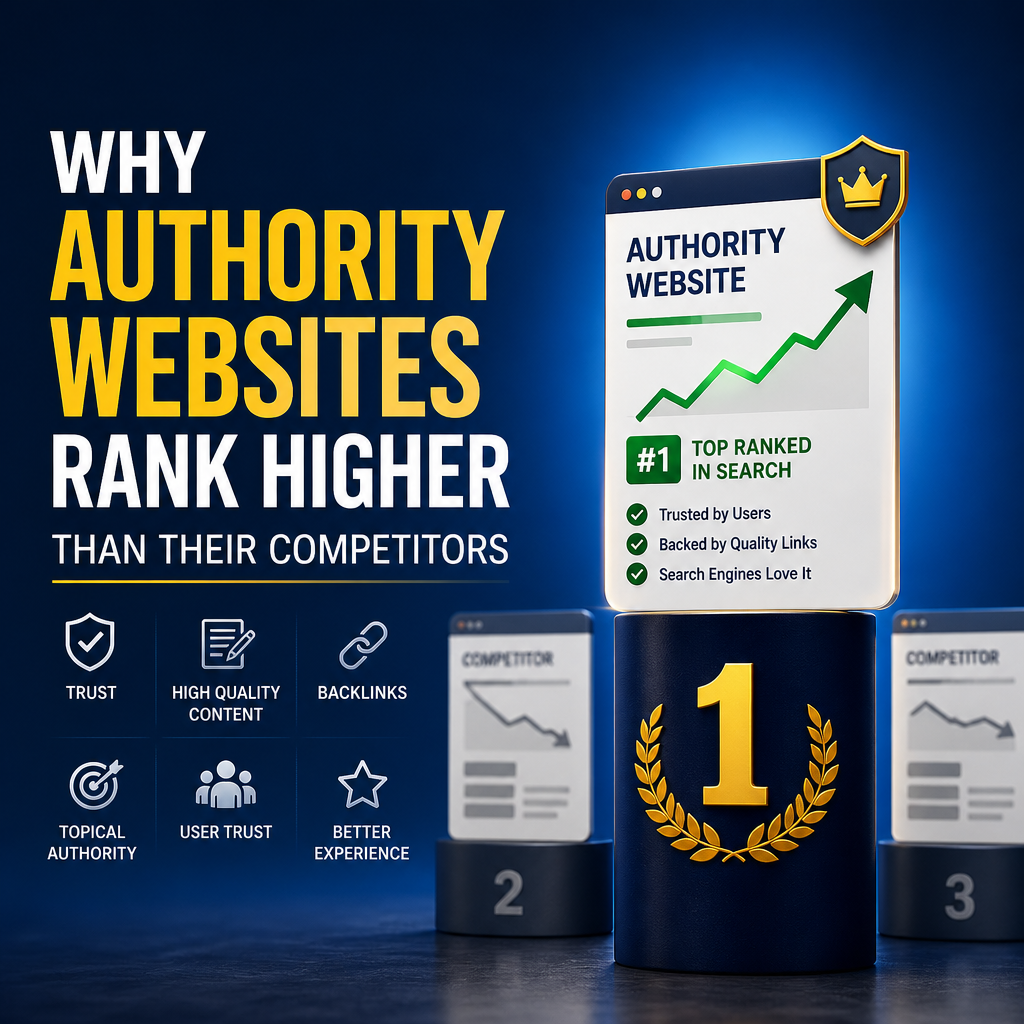
Why Authority Websites Rank Higher Than Their Competitors
Why Authority Websites Rank Higher Than Their Competitors
Search engine results rarely reward websites based on a single factor. A page may contain excellent information, target a relevant keyword, and use technically sound SEO, yet still struggle to outrank a more established competitor.
The reason is often authority.
Authority websites tend to rank higher because search engines view them as more reliable, relevant, useful, and trustworthy sources. They usually have stronger reputations, more high-quality backlinks, better content coverage, greater brand recognition, and a history of satisfying users.
Authority is not simply a score assigned to a website. It is the result of many signals working together over time. Understanding those signals can help businesses and publishers compete more effectively, even when they do not have the resources of major brands.
What Is an Authority Website?
An authority website is a site that has earned strong credibility within a particular topic, industry, or audience.
For example, a website may be considered authoritative because it:
- Publishes accurate and detailed information
- Consistently covers a specific subject
- Attracts references from other respected websites
- Demonstrates expertise and experience
- Earns positive user engagement
- Maintains a trustworthy brand reputation
- Provides a reliable technical and editorial experience
Authority can apply at different levels.
A large health publication might have broad authority across medical topics. A specialist cardiology clinic may have narrower but deeper authority in heart health. Similarly, a national home improvement retailer may be broadly authoritative, while a local contractor may become highly authoritative for remodeling services in a particular city.
This distinction matters because search engines evaluate both the overall reputation of a website and the relevance of individual pages to specific queries.
Authority Is Built Through Multiple Signals
Search engines do not rely on one public metric to determine whether a website deserves to rank. Instead, they analyze numerous signals related to quality, relevance, trust, and user satisfaction.
Important authority signals include:
- Relevant backlinks
- Topical depth
- Content quality
- First-hand expertise
- Brand recognition
- User experience
- Consistent publishing and maintenance
- Strong internal linking
- Clear website structure
- A history of satisfying search intent
These factors reinforce one another. High-quality content can attract backlinks. Backlinks can increase visibility. Greater visibility can build brand awareness. Brand awareness can improve user trust and engagement. The combined effect makes the website increasingly competitive.
Stronger Backlink Profiles
One of the most important reasons authority websites rank higher is that they tend to earn more high-quality backlinks.
A backlink is a link from another website to a page on your site. Search engines may view relevant, editorially earned backlinks as endorsements. When respected websites reference a page, they signal that the content may be useful or credible.
However, not all backlinks carry equal value.
A link from a respected industry publication is usually more meaningful than dozens of links from unrelated, low-quality directories. Search engines consider factors such as:
- The authority of the linking website
- Relevance between the two sites
- The context surrounding the link
- Whether the link appears editorially earned
- The diversity of the website’s backlink profile
- The destination page’s usefulness
Example of Backlink Quality
Imagine two websites selling accounting software.
The first has 1,000 backlinks from low-quality blogs, unrelated directories, and automatically generated pages. The second has 80 backlinks from respected finance publications, software review websites, business associations, and educational institutions.
The second website may be more authoritative despite having fewer links. Its backlinks are more relevant, trustworthy, and likely to reflect genuine recommendations.
Why Competitors Struggle to Catch Up
Authority websites often have years of accumulated backlinks. New competitors may publish a better article today, but they still lack the external validation that established websites have built over time.
This creates a competitive advantage. A strong backlink profile can help a site:
- Rank faster for new content
- Compete for more difficult keywords
- Earn visibility with fewer links to each individual page
- Build trust with users and potential business partners
- Attract additional organic references
Backlinks are not the only ranking factor, but they remain a major reason established websites can outperform newer competitors.
Comprehensive Topical Coverage
Authority websites usually do not publish one isolated article about a subject. They build a network of related content that demonstrates broad and deep topical knowledge.
For example, a website about personal finance might cover:
- Budgeting
- Saving
- Credit scores
- Investing
- Retirement planning
- Taxes
- Insurance
- Debt management
- Mortgage decisions
- Financial terminology
Within each subject, it may publish beginner guides, advanced explanations, comparisons, calculators, case studies, and answers to common questions.
This broad coverage helps search engines understand what the website is about and how deeply it addresses the topic.
Topical Authority Versus Keyword Targeting
A weaker website may create one page targeting “how to start investing.” An authoritative website may cover:
- How investing works
- Different types of investments
- Risk tolerance
- Asset allocation
- Index funds
- Investment fees
- Tax-advantaged accounts
- Common investing mistakes
- Portfolio diversification
- Long-term investment strategies
The second website provides a more complete understanding of the subject. Its pages can support one another through internal links, and its overall content collection demonstrates expertise.
Content Clusters
A common structure for building topical authority is the content cluster.
A content cluster usually includes:
- A broad pillar page
- Several detailed supporting pages
- Internal links connecting related content
- Clear categories and navigation
For example, a website about cybersecurity might have a pillar page about phishing attacks, supported by articles covering:
- Common phishing techniques
- How to identify phishing emails
- Phishing prevention for employees
- Mobile phishing scams
- Business email compromise
- Reporting phishing incidents
- Security awareness training
This structure is valuable because it serves users at different stages of the research process while creating a clear relationship between pages.
Better Content Quality and Search Intent Alignment
Authority websites are often more successful at matching search intent.
Search intent refers to the underlying goal behind a search. A user may be looking to:
- Learn something
- Compare options
- Find a specific website
- Purchase a product
- Complete a task
- Solve a problem
A page can be well-written and still fail if it does not satisfy the reason someone searched.
Common Types of Search Intent
Informational Intent
The user wants an explanation or answer.
Examples include:
- “How does solar energy work?”
- “What is a fixed-rate mortgage?”
- “How do I clean a leather sofa?”
The best result usually provides a clear, comprehensive explanation.
Commercial Investigation
The user is comparing choices before making a decision.
Examples include:
- “Best project management software”
- “Laptop A versus Laptop B”
- “Most reliable accounting platforms”
These searches often require comparisons, evaluations, specifications, pricing information, and practical recommendations.
Transactional Intent
The user is ready to take action.
Examples include:
- “Buy running shoes online”
- “Book a dental appointment”
- “Download invoice software”
The most effective pages make the desired action clear and easy.
Navigational Intent
The user is trying to reach a particular brand or website.
Examples include:
- “Microsoft support”
- “YouTube login”
- “Amazon returns”
Brand recognition typically gives the intended website an advantage.
Why Authority Websites Match Intent Better
Established websites often have more resources for researching audiences, testing page layouts, analyzing search results, and updating content. They are more likely to understand what users expect from a query.
For example, a search for “best noise-canceling headphones” probably requires more than a list of products. Users may expect:
- Testing criteria
- Sound quality information
- Battery life comparisons
- Comfort considerations
- Price ranges
- Strengths and weaknesses
- Recommendations for different use cases
Authority websites often provide this depth because they have developed editorial processes and subject knowledge over time.
Demonstrated Experience and Expertise
Search engines increasingly emphasize the value of content created by people who understand the subject through real experience.
Expertise may come from professional qualifications, industry experience, research skills, or direct use of a product or service. Experience is especially important for topics where practical knowledge affects the quality of advice.
For example, a guide about renovating a kitchen is more useful when it includes:
- Real project costs
- Common construction problems
- Material comparisons
- Installation considerations
- Lessons learned from actual projects
A product review is more credible when the reviewer has genuinely tested the product rather than summarizing manufacturer specifications.
Signals of Expertise
Websites can demonstrate expertise through:
- Author biographies
- Professional credentials
- First-hand observations
- Original research
- Case studies
- Expert interviews
- Citations and references
- Transparent editorial policies
- Clear explanations of methodology
These elements help users assess whether the content comes from a knowledgeable source.
Why Generic Content Underperforms
Generic content often repeats information found elsewhere without adding meaningful insight. It may be grammatically correct but fail to answer practical questions.
Authority websites tend to perform better because they add original value, such as:
- Data from internal research
- Unique examples
- Expert commentary
- Detailed procedures
- Industry-specific experience
- Original images or demonstrations
- Clear opinions supported by evidence
The more a page helps users make decisions or complete tasks, the more likely it is to earn trust and references.
Brand Recognition and User Trust
Search engines can observe patterns that reflect how users interact with brands. Although brand recognition is not a simple ranking shortcut, a trusted brand often has advantages in search.
Users may be more likely to:
- Click a familiar result
- Spend more time on a recognized website
- Search specifically for the brand
- Return to the site later
- Share its content
- Link to it in their own articles
A recognizable brand also tends to generate more unlinked mentions, reviews, discussions, and press coverage.
Brand Searches as a Competitive Advantage
Suppose a user searches for “best email marketing tools.” They may click a familiar publication because they recognize its editorial reputation. A lesser-known website may offer equally useful content, but the user has no established reason to trust it.
Over time, repeated exposure can change this. A smaller publisher that consistently provides accurate, distinctive, and useful content can build recognition and become a preferred source.
Trust Is More Than Visual Design
Professional design can support credibility, but trust depends on more than appearance. A trustworthy website should also provide:
- Accurate contact information
- Clear ownership details
- Transparent policies
- Secure browsing
- Honest product descriptions
- Realistic claims
- Visible editorial standards
- Easy-to-find customer support
Websites that make users question who operates them or how information was produced may struggle to build authority.
Superior Internal Linking
Authority websites often have well-developed internal linking systems.
Internal links connect pages within the same website. They help users discover related information and help search engines understand the site’s structure and the relationships between topics.
Benefits of Internal Linking
A strong internal linking strategy can:
- Distribute authority across important pages
- Help search engines discover new content
- Establish topic relationships
- Guide users to deeper resources
- Improve navigation
- Reduce isolated or orphaned pages
- Support important commercial pages with informational content
For example, an article about “how to choose a business bank account” could link to pages about:
- Business checking accounts
- Monthly account fees
- Online banking security
- Small business taxes
- Cash flow management
These links create a logical path through the subject.
Context Matters
Internal links work best when they are placed naturally within relevant content. Descriptive anchor text is more useful than vague phrases such as “click here.”
Instead of writing:
Learn more by clicking here.
A stronger link might say:
Compare the features of different business checking accounts.
The second version provides context for both users and search engines.
A Better Technical Foundation
Authority websites often invest in technical SEO because a strong reputation cannot compensate indefinitely for a poor user experience.
Technical quality includes:
- Mobile usability
- Fast loading performance
- Secure HTTPS connections
- Crawlable navigation
- Clean URL structures
- Accurate metadata
- Proper canonicalization
- Accessible content
- Functional forms and buttons
- Correct indexing controls
Performance and User Experience
If a page loads slowly, shifts unexpectedly, or is difficult to use on a phone, users may leave before engaging with the content. Poor experiences can reduce conversions, repeat visits, and positive signals associated with the website.
Technical performance also affects how efficiently search engines crawl and process a site. Large websites with thousands of pages particularly benefit from clean architecture and sensible technical controls.
Technical SEO Is a Foundation, Not a Substitute
Technical improvements alone rarely transform a low-quality website into an authority. A fast website with weak, unhelpful content is still unlikely to earn lasting visibility.
Technical SEO is most effective when it supports:
- Valuable information
- Clear site organization
- Strong editorial standards
- Easy content discovery
- Reliable user interactions
Consistent Content Maintenance
Authority websites usually treat content as an ongoing asset rather than a one-time publication.
Information changes. Statistics become outdated. Products are discontinued. Laws are revised. Search intent evolves. Competitors publish better explanations.
Regular maintenance helps keep important pages accurate and useful.
Content Updates May Include
- Replacing outdated statistics
- Updating product specifications
- Correcting broken links
- Adding newly relevant questions
- Improving examples
- Clarifying confusing sections
- Expanding thin explanations
- Removing obsolete recommendations
- Reviewing titles and descriptions
- Refreshing screenshots and images
A website that published a strong guide five years ago may lose visibility if it has not kept the page current.
Freshness Depends on the Topic
Not every article needs frequent updates. A historical explanation may remain useful for years, while a page about software pricing may require updates every few months.
The appropriate update schedule depends on how quickly the subject changes and how important accuracy is to users.
Greater Resources and Editorial Processes
Many authority websites have dedicated teams responsible for research, writing, editing, design, fact-checking, legal review, and SEO.
This does not guarantee quality, but it gives established sites the ability to produce more complete and reliable content at scale.
A mature editorial process may include:
- Topic selection based on audience needs
- Search intent research
- Expert interviews
- Source collection
- Outline development
- Specialist writing
- Editorial review
- Fact-checking
- Search optimization
- Design and multimedia production
- Publication
- Performance monitoring
- Scheduled updates
Smaller businesses may not be able to replicate every step, but even a simplified version can improve content quality.
For example, one person can separate research, writing, and editing into different stages instead of trying to complete everything at once. A subject-matter expert can review the final draft before publication. A quarterly content audit can identify pages that need attention.
Authority Compounds Over Time
Authority has a compounding effect.
An established website may publish a new page and receive faster visibility because:
- Search engines already understand its topical focus
- The domain has a history of quality
- Existing pages can link to the new content
- The website has a regular audience
- The brand can promote the page immediately
- External publishers are more likely to notice it
This does not mean every new page on an authoritative site will rank. Poor content can still fail. However, the site starts with advantages that a new competitor must gradually build.
The Authority Flywheel
A typical authority flywheel looks like this:
- The website publishes useful content.
- Users discover and engage with it.
- Other websites reference it.
- Search visibility improves.
- More users find the brand.
- The brand earns recognition and trust.
- New content receives more attention.
- The cycle continues.
This is why authority is difficult to manufacture quickly. It is often the result of repeated positive interactions over a long period.
Why Smaller Websites Can Still Compete
Large authority websites have advantages, but they are not unbeatable. Smaller websites can outperform them by being more focused, more original, and more useful to a specific audience.
Focus on a Narrow Topic
A small website does not need to become authoritative across an entire industry. It can dominate a specific niche.
For example, instead of covering all outdoor recreation, a site might specialize in:
- Backpacking equipment for beginners
- Accessible hiking trails
- Winter camping in a particular region
- Family-friendly national park trips
Focused expertise can be more valuable than broad but shallow coverage.
Add Original Information
Original content gives competitors a reason to reference your website.
Potential examples include:
- Surveys
- Industry data
- Original experiments
- Product testing
- Expert interviews
- Local research
- Detailed case studies
- Calculators and interactive tools
- Practical templates
A page that offers something unavailable elsewhere has a stronger chance of attracting links and attention.
Serve Users More Precisely
Smaller websites can often respond faster to specific audience needs. They may provide:
- More relevant examples
- More specialized advice
- Better customer support
- Clearer explanations
- More practical instructions
- A stronger community connection
Large websites may have greater reach, but specialized publishers can often provide greater relevance.
Build Relationships for Relevant Links
Rather than pursuing large numbers of backlinks, focus on earning links from websites connected to your subject.
Effective approaches include:
- Partnering with professional organizations
- Contributing expert insights to industry publications
- Creating resources journalists can cite
- Participating in legitimate community initiatives
- Collaborating with complementary businesses
- Publishing research worth referencing
The goal should be genuine usefulness, not artificial link volume.
Common Mistakes That Prevent Authority Growth
Some websites remain weak despite publishing frequently because they focus on the wrong activities.
Publishing Large Amounts of Generic Content
More pages do not automatically create more authority. If every article repeats existing information without adding value, the website may become difficult to distinguish from competitors.
Chasing Keywords Without Understanding Intent
A page built around a keyword but disconnected from the user’s goal may attract impressions without earning clicks, engagement, or conversions.
Ignoring Existing Content
Publishing new material while leaving important older pages inaccurate or incomplete can weaken the overall site experience.
Using Unreliable Sources
Unsupported claims, unattributed statistics, and exaggerated promises reduce trust. Strong content should make it clear where important information comes from.
Overusing Artificial Optimization
Keyword stuffing, manipulative links, misleading titles, and unnatural copy may create short-term improvements but expose the site to long-term risks.
Neglecting Trust Signals
A website with no author information, unclear ownership, broken contact details, or aggressive advertising may struggle to persuade users that it is credible.
A Practical Authority-Building Framework
Businesses and publishers can use the following framework to strengthen their websites.
1. Define the Core Subject
Identify the area in which the website wants to become known. Avoid trying to cover every possible topic.
2. Analyze the Audience
Understand the questions, concerns, buying decisions, and practical problems faced by the target audience.
3. Map Topic Coverage
Create a list of core subjects, supporting questions, comparisons, definitions, and advanced topics. Organize them into logical clusters.
4. Improve Existing Pages
Review current content for accuracy, depth, clarity, originality, and search intent alignment before producing large amounts of new material.
5. Demonstrate Experience
Add examples, case studies, methodology, author credentials, original observations, and first-hand evidence where appropriate.
6. Strengthen Internal Links
Connect related pages using natural, descriptive links. Make important content easy to reach from relevant sections of the site.
7. Earn Relevant Mentions
Create resources that industry websites, journalists, educators, associations, and communities will find genuinely useful.
8. Improve Technical Performance
Ensure that pages are secure, mobile-friendly, accessible, fast, and easy for search engines to crawl.
9. Monitor Results
Track rankings, organic traffic, engagement, conversions, backlinks, and user feedback. Use the data to improve decisions rather than relying on rankings alone.
10. Maintain the Site Consistently
Schedule content reviews, update important pages, repair broken links, and remove information that no longer serves users.
Conclusion
Authority websites rank higher because they provide stronger evidence of value, relevance, expertise, and trust. Their advantages come from more than domain age or backlink quantity. They have usually developed comprehensive content, reliable technical foundations, strong reputations, useful internal structures, and a consistent history of satisfying users.
Authority is also achievable for smaller websites. The most effective path is not to imitate the largest competitors page by page. It is to focus on a defined audience, publish genuinely useful information, demonstrate real expertise, earn relevant references, and improve the entire website over time.
Search visibility is often the result of accumulated trust. The websites that consistently help users, support their claims, maintain their information, and contribute something valuable to their industry are the ones most likely to build lasting authority—and outrank their competitors.
